

Tests Used to Diagnose Autoimmune Diseases play a vital role in identifying autoimmune disorders and guiding timely treatment. Autoimmune diseases happen when our own immune systems attack healthy parts of our bodies, and this results in harm rather than protection from nasty bacteria and viruses. According to a 2023 population-based study published in The Lancet, autoimmune diseases affect approximately 1 in 10 people.
Diagnosis can be very challenging because many autoimmune diseases share just simple symptoms such as fatigue, joint pain, muscle weakness, skin rashes, and unexplained fever. Knowing how the doctor diagnoses autoimmune disease will help you know what to expect with the diagnosis.
In this article, you’ll learn about 10 essential tests for autoimmune diseases, what each test is used for, and why early diagnosis is important.
What’s an Autoimmune Disease?
Autoimmune diseases are conditions in which the immune system mistakenly attacks healthy tissues instead of protecting the body from harmful bacteria and viruses. Normally, our immune systems help to keep us safe from various bacteria, viruses and other things that aren’t so good for us. It cannot tell between healthy cells and harmful substances in autoimmune diseases.
There are at least 80 different autoimmune disorders identified. Autoimmune diseases happen when the immune system begins targeting healthy tissues in your body. Some of them affect only one organ, but others affect several organs and body systems. This can cause conditions such as rheumatoid arthritis, lupus, multiple sclerosis, Hashimoto’s thyroiditis, and celiac disease.

With the use of appropriate treatment at an early stage, it can help alleviate the symptoms. It restricts the inflammation from becoming non-reversible and avoids complications in the long run.
Common types of autoimmune diseases
More than 80 autoimmune diseases have been identified, affecting different organs and body systems. Certain forms attack only a single organ, whereas other forms can impact different organs throughout the entire body. Common Types of Autoimmune Diseases:
- Rheumatoid Arthritis (RA): Causes pain, swelling, stiffness in joints.
- Lupus (SLE): Can affect the skin, joints, kidneys, heart, lungs and brain.
- Multiple Sclerosis (MS): Also damages nerves, causing muscle weakness and vision problems.
- Type 1 Diabetes: Type 1 diabetes destroys insulin-producing cells in the pancreas.
- Hashimoto’s Thyroiditis: Results in an under-active thyroid gland (hypothyroidism).
- Graves’ disease: Causes an overactive thyroid (hyperthyroidism).
- Psoriasis: Results in red, scaly skin lesions.
- Celiac Disease: Celiac disease damages the lining of the small intestine after gluten exposure.
- Sjögren’s Syndrome: It causes dry eyes and dry mouth.
- Inflammatory bowel disease (IBD): Inflammatory bowel disease (IBD) includes Crohn’s disease and ulcerative colitis.
- Scleroderma (or systemic sclerosis): This is a disease causing hardening of the skin and the member inside.

Main causes of autoimmune diseases
Experts say they still have no clear idea why autoimmune diseases happen. Though it’s possible they result from an interaction among many genes, the environment, hormones and aspects of the immune system. Common Causes and Risk Factors:
- Genetics: Inheritance of genes.
- Family history: A close relative with an autoimmune disorder increases your risk.
- Infections: Some infections caused by viruses or bacteria can lead to the disease.
- Hormonal changes: More common in women due to hormonal influences.
- Environmental Factors: Smoking, pollution and chemicals, UV exposure
- Impact of Chronic Stress: It can cause immune system dysfunction and lead to flares.
- Diet and gut health: Have an impact on the immune system.
- Vitamin D3 Deficiency: Associated with some autoimmune diseases
- Specific Medications: While uncommon, several other medications can also initiate autoimmune responses.
The majority of autoimmune disorders are multifactorial rather than monogenic.
General symptoms of autoimmune diseases
Typical signs of autoimmune conditions include:

- Persistent fatigue
- Joint pain and swelling
- Muscle pain or weakness
- Skin rash
- Mild fever
- Hair loss
- Digestive problems
- Dry eyes and mouth
- Numbness or tingling
- Unexpected weight change
- Swollen lymph glands
- Brain fog
Depending on your type of autoimmune disorder, symptoms may vary. If you don’t know, you should consult a medical doctor if symptoms persist or increase.
How Doctors Diagnose Autoimmune Diseases
Doctors diagnose autoimmune disease commonly based on medical history information, physical examination, symptoms, and family medical history. Since this condition can present with symptoms that are similar to those associated with many autoimmune diseases. There is not one individual test available that helps to make the diagnosis.
While true, your physician utilizes a combination of imaging, blood tests, and, if necessary, a biopsy, to find inflammation, autoantibodies test. Through these tests, doctors evaluate the organ function and involvement to rule out other possible causes of disease. This step helps doctors make an accurate diagnosis and choose the appropriate treatment at the right time.
Why Are Multiple Tests Needed?
An autoimmune disease can take a very long time to progress. It typically affects more than one area or more than one body organ, and the symptoms are easily mistaken for other conditions. As a result, a number of tests are often employed to determine:
- Confirm immune system abnormalities
- Detect inflammation
- Identify disease-specific antibodies
- Evaluate organ damage
- Rule out other medical conditions
10 Essential Tests Used to Diagnose Autoimmune Diseases
To accurately diagnose your autoimmune disease, your doctor will likely order a combination of tests. The following 10 critical tests can help spot inflammation, identify disease-specific autoantibodies, screen for organ involvement and support an autoimmune disease diagnosis.
Tests Used to Diagnose Autoimmune Diseases: Summary Table
| Test | Purpose | Common Conditions |
| Antinuclear Antibody (ANA) | Screens for autoimmune antibodies | Lupus, Sjögren’s syndrome, and systemic sclerosis |
| Complete Blood Count (CBC) | Detects anemia and blood cell abnormalities | Lupus, rheumatoid arthritis, and Sjögren’s syndrome |
| C-Reactive Protein (CRP) | Measures inflammation | Rheumatoid arthritis, vasculitis, and IBD |
| Erythrocyte Sedimentation Rate (ESR) | Detects and monitors inflammation | Lupus, rheumatoid arthritis, and vasculitis |
| Rheumatoid Factor (RF) | Helps diagnose rheumatoid arthritis | Rheumatoid arthritis, and Sjögren’s syndrome |
| Anti-Cyclic Citrullinated Peptide (Anti-CCP) | Confirms early rheumatoid arthritis | Rheumatoid arthritis |
| Thyroid Antibody Tests | Detect autoimmune thyroid disorders | Hashimoto’s thyroiditis, and Graves’ disease |
| Complement Blood Tests (C3 & C4) | Monitors immune activity | Lupus (SLE), and lupus nephritis |
| Autoantibody Panel | Identifies disease-specific autoantibodies | Lupus, MCTD, Sjögren’s syndrome, and vasculitis |
| HLA-B27 Test | Detects the HLA-B27 genetic marker | Ankylosing spondylitis, Reactive arthritis, Psoriatic arthritis, and Enteropathic arthritis |
1. Antinuclear Antibody (ANA) Test
An ANA test is a diagnostic screening tool for autoimmune conditions which helps to check the presence of certain antibodies in your body. It may identify the presence of autoantibodies that recognize and attack the body’s healthy cells. A positive ANA test indicates the presence of antinuclear antibodies, which may be associated with autoimmune diseases.
Normal Values
- Negative: Normal
- Positive: by titer (1:40, 1:80, 1:160, 1:320)
- ≥1:160: Consistent with serological disease (symptomatic or asymptomatic).
What the Results Reveal
- Positive ANA: Suggests lupus (SLE), Sjögren syndrome, systemic sclerosis, mixed connective tissue disease (MCTD), or autoimmune hepatitis.
- Negative ANA: Less likely an autoimmune disorder
3. Complete Blood Count (CBC)
A CBC or complete blood count test is done to monitor the level of RBC (red blood cell), WBC (white blood cell), hemoglobin, and platelets. It is not an autoimmune diagnosis test, but it helps to analyze different conditions such as inflammation or anemia.
Normal Values
| Test | Normal Adult Range |
| Red Blood Cells (RBC) | Men: 4.7–6.1 million/µL Women: 4.2–5.4 million/µL |
| Hemoglobin (Hb) | Men: 13.5–17.5 g/dL Women: 12.0–15.5 g/dL |
| White Blood Cells (WBC) | 4,000–11,000 cells/µL |
| Platelets | 150,000–450,000/µL |
| Hematocrit (Hct) | Men: 41–53% Women: 36–46% |
What the Results Reveal
- Low RBC or Hemoglobin: May indicate anemia related to lupus or chronic inflammation.
- Low WBC: Common in lupus and Sjögren’s syndrome.
- High WBC: May suggest inflammation or infection.
- Low Platelets: Can occur in lupus or immune thrombocytopenia (ITP).
- High Platelets: Often linked to chronic inflammation, especially rheumatoid arthritis.
3. C-Reactive Protein (CRP) Test
The CRP or C – reactive protein blood test determines inflammatory conditions in the body. The test assists the medical provider with monitoring activity with regard to an autoimmune illness. However, it is unable to indicate that there is a specific autoimmune disease.
Normal Values
- Normal: <10 mg/L (depends on the laboratory)
- High: >10 mg/L High level implies large-scale inflammation
What the Results Reveal
- Normal CRP: Basically no active inflammation.
- Moderately Elevated CRP: Usually indicates a short-term low-level inflammation or low-grade infection.
- High CRP: you’ll find it with rheumatoid arthritis, vasculitis, inflammatory bowel disease (IBD), and active autoimmune disease.
4. Erythrocyte Sedimentation Rate (ESR)
The Erythrocyte Sedimentation Rate (ESR) blood test estimates how fast your red blood cells settle down to the bottom of a test tube in one hour. If your red blood cells settle down in the test tube at a faster-than-average rate, inflammation may be underlying your condition, like an autoimmune condition.
Although ESR alone cannot make a diagnosis of an autoimmune disorder, it will confirm the presence of inflammation.
Normal Values
| Age/Sex | Normal ESR |
| Men (under 50 years) | 0–15 mm/hour |
| Women (under 50 years) | 0–20 mm/hour |
| Men (over 50 years) | 0–20 mm/hour |
| Women (over 50 years) | 0–30 mm/hour |
What the Results Reveal
- Normal ESR: Little or no active inflammation.
- High ESR: High ESR: May indicate inflammation associated with rheumatoid arthritis, lupus, vasculitis, or other autoimmune diseases.
- Low ESR: Usually not clinically significant but should be interpreted with other test results.
5. Rheumatoid Factor (RF) Test
The Rheumatoid Factor (RF) test is used to test the level of rheumatoid factor antibodies in the blood. This blood test is also used by your doctor to help in the diagnosis of certain autoimmune disorders, as well as rheumatoid arthritis. A positive RF result alone does not confirm RA.
Normal Values
- NegativeRF: <14 IU/mL (may vary by laboratory)
- Positive RF: ≥14 IU/mL
What the Results Reveal
- Negative RF: RA is rare but not excluded.
- RF test positive: May suggest rheumatoid arthritis, Sjogren’s syndrome, lupus (SLE), mixed connective tissue disease, or, rarely, chronic infections.
6. Anti-Cyclic Citrullinated Peptide (Anti-CCP) Test
Rheumatoid factor (RF) is an antibody that is present in the blood of some individuals with rheumatoid arthritis. An anti-CCP test also helps to detect CCPs, another type of antibody. In people who have rheumatoid arthritis, an anti-CCP test is more accurate than an RF test at helping diagnose the disease and assess its progression.
Normal Values
- Negative :< 20 U/mL (laboratory dependent)
- Positive: ≥20 U/mL
What the Results Reveal
- Negative anti-CCP: less likely but not excluded rheumatoid arthritis.
- Positive Anti-CCP: Strongly predicts early rheumatoid arthritis and may correlate with higher likelihood of joint damage and more aggressive disease progression.
7. Thyroid Antibody Tests
The thyroid antibody test can detect if your body is developing antibodies to attack the thyroid gland. This thyroid blood test is usually requested to help confirm that you have an autoimmune disease that is affecting your thyroid gland, such as Graves’ or Hashimoto’s thyroiditis.
Normal Values
- Anti-TPO: <35 IU/mL
- Thyroglobulin Antibody (TgAb): <20 IU/mL (That can differ from lab to lab)
What the Results Reveal
- Results: Autoimmune thyroid disease is unlikely, however, normal results
- High Anti TPO: can indicate Hashimoto’s thyroiditis or Graves’ disease.
- High TgAb: Often with Hashimoto’s thyroiditis.
8. Complement Blood Tests (C3 and C4)
Complement blood tests (C3 and C4) measure key proteins that are part of the immune system circulating in the blood. If a person has abnormal amounts of these proteins, it can aid a doctor in determining the presence and stage of autoimmune disease, like lupus (SLE).
Normal Values
- C3: 90–180 mg/dL
- C4: 10–40 mg/dL
Laboratory-specific reference ranges.
What the Results Reveal
- C3 and C4 normal: Complement levels are normal.
- Low C3 and/or C4: Suggestive of lupus (SLE), lupus nephritis, or other immune complex–mediated SLE type autoimmune disorders.
- C3 or C4 Raised: Seen in acute inflammation or infection, and is usually not very helpful in diagnoses of autoimmune diseases.
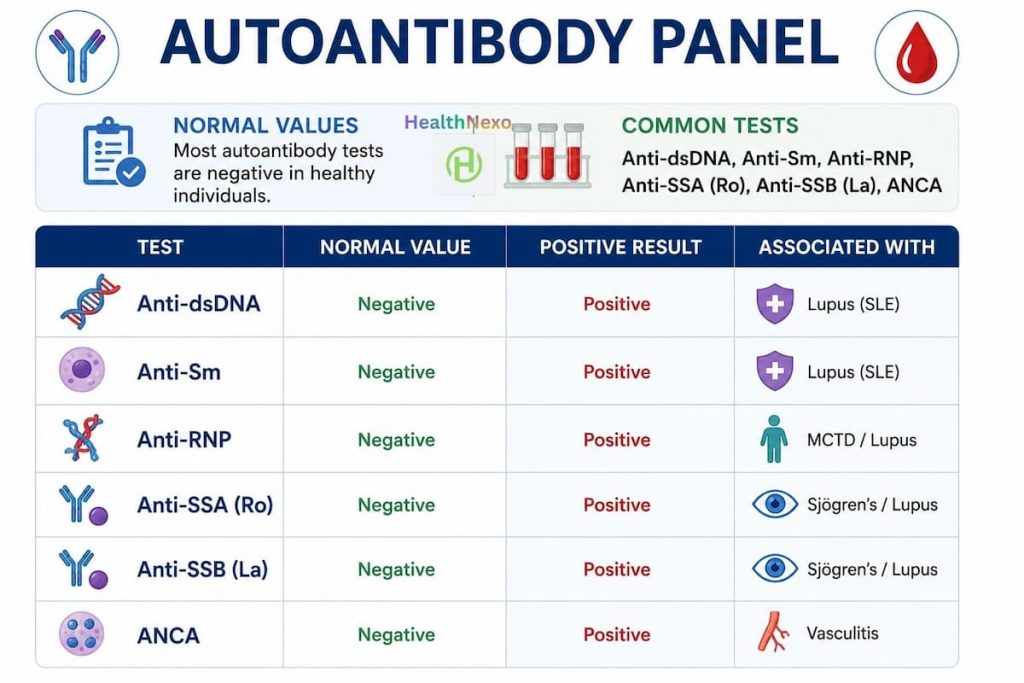
9. Autoantibody Panel
Autoantibody panel blood test performed to screen for the presence of autoantibodies typically found in people who have an autoimmune disorder. If the patient’s signs and symptoms can be attributed to another illness, it may be a useful tool in diagnosis.
Normal Values
- Most autoantibody tests are negative in healthy individuals.
- Common tests include Anti-dsDNA, Anti-Sm, Anti-RNP, Anti-SSA (Ro), Anti-SSB.
(La), and ANCA.
What the Results Reveal
- Positive Anti-dsDNA: Strongly suggests systemic lupus erythematosus (SLE).
- Positive Anti-Sm: Highly specific for lupus.
- Positive Anti-RNP: May indicate mixed connective tissue disease (MCTD) or lupus.
- Positive Anti-SSA (Ro) / Anti-SSB (La): Common in Sjögren’s syndrome and may also occur with lupus.
10. HLA-B27 Test
The HLA-B27 blood test looks for a genetic marker called the HLA-B27 protein, which is carried on the surface of your white blood cells. This marker doesn’t mean you have an autoimmune condition, but it indicates that you have a greater risk of developing some autoimmune and inflammatory disorders.
Normal Value
- Negative: HLA-B27 not detected (normal)
- Positive: HLA-B27 detected
Reference ranges may vary slightly between laboratories.
What the Results Reveal
- Negative HLA-B27: Makes HLA-B27–associated diseases less likely, but does not completely rule them out.
- Positive HLA-B27: May be associated with ankylosing spondylitis, reactive arthritis, psoriatic arthritis, enteropathic arthritis, and acute anterior uveitis.
Note: A positive HLA-B27 result is not a diagnosis by itself. Many healthy people carry the HLA-B27 gene and never develop an autoimmune disease.
Can One Test Confirm an Autoimmune Disease?
No. Most autoimmune diseases can’t be confirmed with one test. An accurate diagnosis is usually made by doctors combining a history, physical examination, blood tests, imaging studies and, when necessary, a biopsy. Such a broad-spectrum application enhances diagnostic accuracy.
When Should You See a Doctor?
Only see a health care provider if you have:
- Persistent fatigue
- Joint pain or swelling
- Muscle weakness
- Skin rashes
- Unexplained fever
- Hair loss
- Digestive problems
- Dry eyes or dry mouth
- Numbness or tingling
- Unexplained weight changes
Evaluation at an early stage may lead to prevention of complications and better long-term outcomes.
Bottom Line
Knowing the tests used to diagnose autoimmune diseases is essential to getting those challenging conditions identified at the early stage. Since there is no single test that can diagnose every autoimmune disorder. Doctors use a combination of blood tests, antibody tests, genetic tests, imaging studies (when needed), and your medical history to make an accurate diagnosis.
These 10 important tests are used by doctors to find signs of inflammation, disease-specific antibodies, assess which organs are involved, and guide them toward the correct diagnosis. These tests also find out whether an organ is being affected and find out whether there might be some other disorder going on.
With timely testing, doctors can get to an early and precise diagnosis. Early detection allows for timely intervention, decreased long-term effects, and a better life for a patient. Getting the right tests at the right time is key in managing autoimmune diseases and supporting your future health.
Frequently Asked Questions (FAQs)
Q1. Can one test diagnose an autoimmune disease?
No. In addition to tests, your doctor uses your symptoms and medical history.
Q2. What Is the Initial Test for Autoimmune Disease Screening?
The ANA, CBC, CRP, and ESR tests are commonly used as initial screening tests.
Q3. What Does a Positive ANA Test Indicate?
An autoimmune disease might lead to a positive ANA test, but this test should not be relied upon as definitive.
Q4. Which test is best for rheumatoid arthritis?
The Anti-CCP test, often combined with the RF test, is highly accurate for rheumatoid arthritis.
Q5. Why are CRP and ESR tests performed?
They help detect inflammation and monitor autoimmune disease activity.
Q6. Can autoimmune diseases have normal test results?
Yes. Early-stage autoimmune diseases may show normal blood test results.
Q7. Which doctor treats autoimmune diseases?
A rheumatologist usually diagnoses and treats autoimmune diseases. Depending on the condition, you may also need an endocrinologist, neurologist, or gastroenterologist.
References
- The Lancet. Global Epidemiology of Autoimmune Diseases. 2023.
- National Institute of Arthritis and Musculoskeletal and Skin Diseases (NIAMS). Autoimmune Diseases.
- National Institute of Allergy and Infectious Diseases (NIAID). Autoimmune Diseases.
- American College of Rheumatology (ACR). Autoimmune Diseases.
- EULAR. Clinical Practice Recommendations for Autoimmune Diseases.
- MedlinePlus. Autoimmune Disorders.
- ARUP Consult. Autoimmune Disease Testing.
- Mayo Clinic. Autoimmune Diseases: Symptoms and Causes.
- Cleveland Clinic. Autoimmune Diseases.
- Merck Manual Professional Edition. Autoimmune Disorders.
- MSD Manual Professional Edition. Autoimmune Disorders.
- ADLM (formerly AACC). Laboratory Testing for Autoimmune Diseases.
⚕️ Medical Disclaimer
The information provided in this article is for educational and informational purposes only. It is not intended to be a substitute for professional medical advice, diagnosis, or treatment. Always consult a qualified healthcare professional before making any medical decisions, starting any treatment, or changing your current healthcare plan.
Tags:

Md. Rakibul Hasan, BSc (Hons), MS (Thesis)
Biochemistry & Molecular Biology, University of Chittagong, Bangladesh
Senior Biochemist | Health Content Writer | Evidence-Informed Health Information Creator
Popular Diagnostic Centre Limited, Bangladesh.
He specializes in clinical biochemistry, laboratory diagnostics, and medical testing. Alongside his professional work, he is actively involved in health education and scientific communication.
As a Health Content Writer and Research-Based Health Information Creator, he simplifies complex medical and biochemical topics into clear, evidence-informed, and reader-friendly health information.



1 thought on “10 Essential Tests Used to Diagnose Autoimmune Diseases: What They Reveal About Your Health”