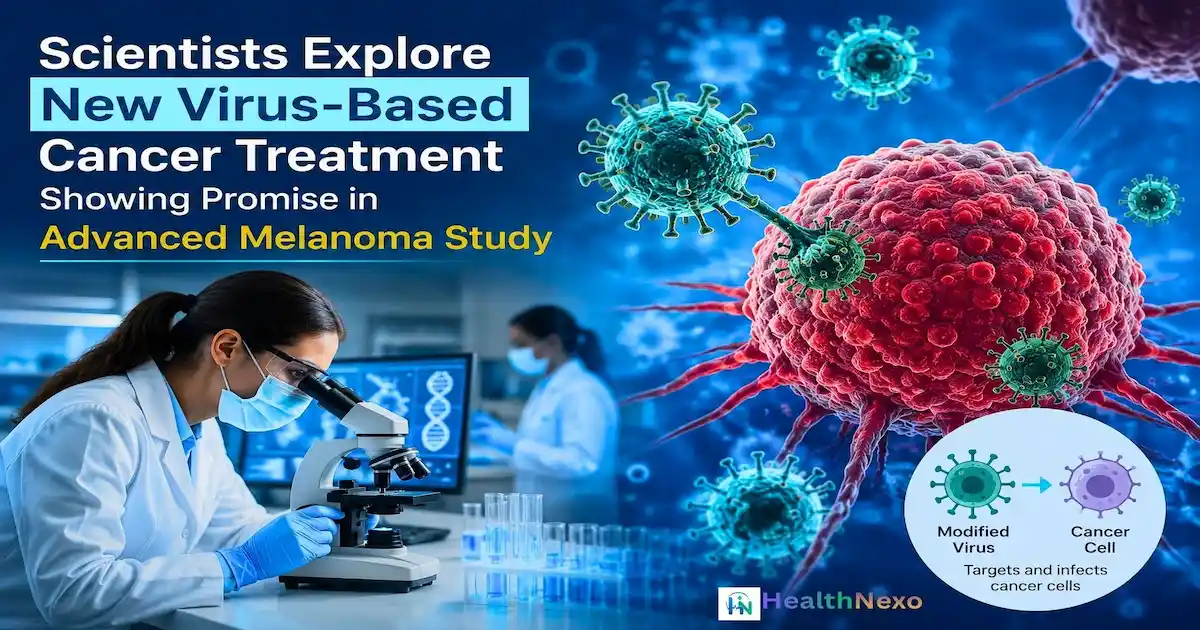
Scientists are studying a new virus-based cancer treatment that uses a modified virus to target cancer cells. This kind of therapy can also assist in eliciting the immune reaction towards the cancer cells. One of the therapies that are undergoing testing is the one which uses vusolimogene oderparepvec (RP1) and nivolumab for advanced melanoma.
It is an oncolytic virus based on HSV-1, reviewed by the FDA at the advisory committee meeting held on July 30, 2026.
How Does Virus-Based Cancer Treatment Work?
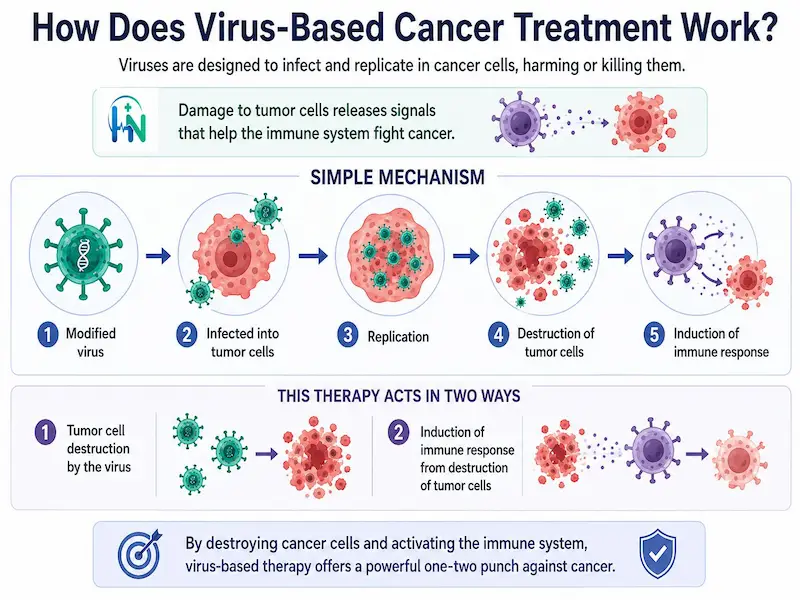
These viruses are designed or selected for infection and replication in cancer cells. If the virus replicates within a suitable tumor cell, then it can harm or kill the cell. Tumor cell damage will also be able to cause release of signals which help the immune system identify and kill cancer cells.
Simple mechanism:
Modified virus → Infected into tumor cells → Replication → Destruction of tumor cells → Induction of immune response
This therapy can thus act in two primary ways:
- Tumor cell destruction by the virus.
- Induction of immune response from the destruction of the tumor cells.
What Is Vusolimogene Oderparepvec?
Oderparepvec or vusolimogene, commonly referred to as RP1, is an investigational therapy that has been developed on the basis of HSV-1. This virus has been genetically engineered such that it expresses a fusogenic protein and granulocyte macrophage colony-stimulating factor.
This is expected to help in eliminating the tumor cells and stimulation of the immune system. It is administered directly into the tumors, and it is being investigated whether it triggers an immune response against untreated tumors.
What Did the IGNYTE Trial Find?
The IGNYTE study (NCT03767348) involved the combination therapy of vusolimogene oderparepvec and nivolumab in patients with advanced melanoma. These were adult patients who had tumors that kept progressing despite anti-PD-1 therapy.
The reported Phase 2 study included:
- Open-label design
- Multicenter study
- Single-arm design
- 140 patients
Reported Trial Results
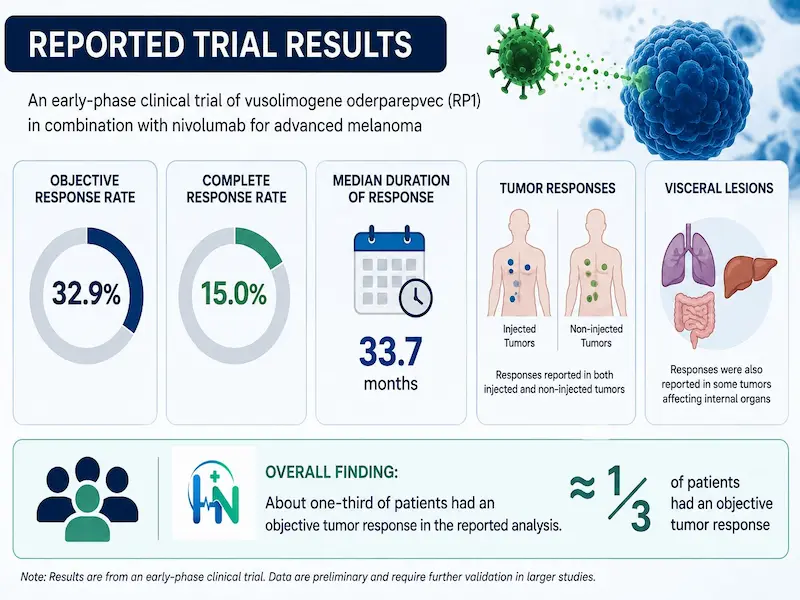
- Objective response rate: 32.9%
- Complete response rate: 15.0%
- Median duration of response: 33.7 months
- Tumor responses: Reported in both injected and non-injected tumors
- Visceral lesions: Responses were also reported in some tumors affecting internal organs
- Overall finding: About one-third of patients had an objective tumor response in the reported analysis.
Why Are the Results Important?
These results indicate that vusolimogene oderparepvec might be able to aid in the fight against cancer cells in certain patients with metastatic melanoma. Reactions occurred in certain tumors without injection. This may suggest that the drug has the ability to produce an immune response without having to inject the drug into the tumor.
The findings should be interpreted with caution:
- The IGNYTE trial is a one-arm study; hence, there was no random control arm.
- The patients received the virus in combination with nivolumab.
- It is hard to identify what percentage of benefits each treatment caused.
Why Is Nivolumab Combined With the Virus?
Nivolumab is a PD-1 immune checkpoint inhibitor, which helps to inhibit the PD-1 pathway and hence allow the T cells to continue being activated to fight the cancer. It is hoped that the combination of these two treatments will complement each other in:
- Oncoytic Virus Treatment: Attacks cancer cells and also stimulates immune system reactions.
- Nivolumab Treatment: Inhibits PD-1 pathway and hence activates T cells.
What Are the Potential Benefits and Challenges?
Researchers are investigating modified viruses for cancer treatment because they may potentially:
- Target tumor cells
- Destroy infected cancer cells
- Stimulate anti-cancer immunity
- Work with existing immunotherapies
- Produce immune effects beyond directly treated tumors
However, important challenges remain, including:
- Treatment safety
- Delivering enough virus into tumors
- Biological differences between tumors
- Immune responses against the virus
- Uncertainty surrounding results from non-randomized studies
- Larger randomized clinical trials are needed to better understand the treatment’s benefits and risks.
What Is the Current FDA Status?
- On August 6, 2026, the U.S. FDA granted accelerated approval to vusolimogene oderparepvec-wtpg (Tudriqev) in combination with nivolumab.
- The approval is for adults with unresectable advanced cutaneous melanoma that has progressed after a PD-1-blocking antibody-based treatment.
- Because this is an accelerated approval, additional studies are needed to confirm the treatment’s clinical benefit.
- The ongoing IGNYTE-3 Phase 3 trial is being conducted as a confirmatory study.
What Happens Next?
Researchers are continuing to evaluate the treatment in the randomized IGNYTE-3 Phase 3 trial (NCT06264180).
The study compares:
- Vusolimogene oderparepvec + nivolumab
- Physician’s choice of treatment
- The trial is studying patients with advanced cutaneous melanoma whose cancer has progressed after previous treatment.
- The planned enrollment is approximately 400 patients.
The primary endpoint is:
- Overall survival
Other outcomes include:
- Progression-free survival
- Objective response rate
- The trial results may help show whether this treatment works better than existing treatment options.
The Future of Virus-Based Cancer Treatment
Cancer treatment based on virus infection is one of the new fields of research in oncology. Researchers try to make such oncolytic viruses more specific and efficient for patients, as well as more capable of stimulating the immune response to cancer.
Future clinical trials will help determine:
- Which patients would be more responsive?
- Which type of tumor would respond well?
- How could they be safely delivered?
- If they could enhance cancer outcomes
Is Virus-Based Cancer Treatment a Cure for Cancer?
No. Virus therapy for cancer is not a universal remedy for cancer. While some oncolytic virus therapies are FDA-approved for treating certain cancers, others are undergoing trials.
Their efficiency may depend on the following factors:
- Type of cancer
- Characteristics of the tumor
- Stage of the disease
- History of previous treatments
- Approach to treatment
- Immune system of an individual
Key Takeaways
Vusolimogene oderparepvec-wtpg (Tudriqev) received FDA accelerated approval in August 2026 in combination with nivolumab for certain adults with advanced cutaneous melanoma.
- Cancer treatment using viruses represents a relatively new field in cancer research.
- Modified viruses have the potential of killing the cancerous cells and inducing anti-cancer immunity in patients.
- One of such cancer treatments utilizing a modified form of HSV-1 is called vusolimogene oderparepvec (RP1).
- In the IGNYTE study, the objective response rate was found to be 32.9%.
- This was a single-arm study and therefore randomized studies are required.
- The ongoing IGNYTE-3 phase 3 trial will be aimed at assessing the clinical benefits of the treatment.
- Vusolimogene oderparepvec cannot be referred to as an FDA-approved treatment until its current FDA approval status is checked.
References
- FDA – Vusolimogene Oderparepvec Accelerated Approval, August 2026
- FDA – July 30, 2026 Advisory Committee Materials
- PubMed – IGNYTE Trial: RP1 + Nivolumab in Advanced Melanoma
- ClinicalTrials.gov – IGNYTE-3, NCT06264180
 Medical Disclaimer
 Medical Disclaimer
The information provided in this article is for educational and informational purposes only. It is not intended to be a substitute for professional medical advice, diagnosis, or treatment. Always consult a qualified healthcare professional before making any medical decisions, starting any treatment, or changing your current healthcare plan.
Tags:

Md. Rakibul Hasan, BSc (Hons), MS (Thesis)
Biochemistry & Molecular Biology, University of Chittagong, Bangladesh
Senior Biochemist | Health Content Writer | Evidence-Informed Health Information Creator
Popular Diagnostic Centre Limited, Bangladesh.
He specializes in clinical biochemistry, laboratory diagnostics, and medical testing. Alongside his professional work, he is actively involved in health education and scientific communication.
As a Health Content Writer and Research-Based Health Information Creator, he simplifies complex medical and biochemical topics into clear, evidence-informed, and reader-friendly health information.