Dengue is a viral infection caused by four dengue virus serotypes (DENV-1 to DENV-4). Early symptoms such as fever, headache, pain behind the eyes, muscle and joint pain, nausea, vomiting, and rash can look similar to chikungunya, Zika, and other infections. Because symptoms alone cannot confirm dengue, Blood Tests for Dengue Diagnosis can help identify the infection.
The duration for which the patient remains ill is an essential factor to consider when choosing the right test for dengue. NS1 and NAAT/RT-PCR are most useful during the first 7 days of illness, while dengue IgM becomes increasingly useful as the illness progresses.
CBC will give additional information. Fluctuations in white blood cells, platelets, and hematocrit can be used to gauge the progression of disease, but CBC cannot be used to diagnose dengue.
Quick Summary
- NS1 and NAAT/RT-PCR: Most useful during the first 7 days.
- IgM: Becomes more useful from around days 4–5, especially after day 7.
- CBC: Platelets and hematocrit help monitor disease, but cannot confirm dengue alone.
- Negative tests: Early negative results do not always rule out dengue; follow-up testing may be needed.
- Clinical assessment: Symptoms, illness day, test results, and laboratory trends should be considered together.
Why Blood Testing Matters in Dengue
Dengue testing has two main roles:
- Confirming infection: Using dengue-specific tests such as NS1, NAAT/RT-PCR, or antibody testing.
- Monitoring disease: Using CBC, platelet count, and hematocrit to assess changes during illness.
The distinction between NS1, NAAT/RT-PCR, and CBC techniques is that while the former two identify the disease, the latter assists the doctor in monitoring the state of the patient. The World Health Organization recommends considering some aspects when selecting the technique for diagnosis.
Blood Tests for Dengue Diagnosis
Dengue-Specific Tests
- NS1 antigen: Detects dengue non-structural protein 1 during the acute phase.
- NAAT/RT-PCR: NAAT/RT-PCR: Detects dengue viral RNA and can confirm an acute dengue infection when positive.
- Dengue IgM: Detects antibodies associated with recent infection.
- Dengue IgG: Has a limited role and is not recommended alone for diagnosing acute dengue.
Supportive Tests
- Complete blood count (CBC)
- Platelet count
- Hematocrit
- White blood cell count
- Liver tests when clinically indicated
5 Important Blood Tests and Laboratory Assessments for Dengue
1. Dengue NS1 Antigen Test
NS1 is a dengue virus antigen that can be found in the bloodstream during the early stage of infection. The test is especially helpful in the first 7 days following the symptoms. A positive NS1 test suggests that a person has an active dengue virus infection.
Clinical Significance
NS1 testing is useful since it helps diagnose dengue infection at the acute stage before antibodies develop. It thus becomes very useful when a patient has just been infected with dengue and has developed symptoms of the disease. It should be noted that a negative result from NS1 does not exclude the possibility of dengue. The detection of dengue virus infection may depend on the duration of the illness, the prior presence of dengue infection, and the quality of the test.
Result interpretation:
- Positive: Supports dengue virus infection.
- Negative: Does not completely exclude dengue, particularly when testing is performed early or clinical suspicion remains high.
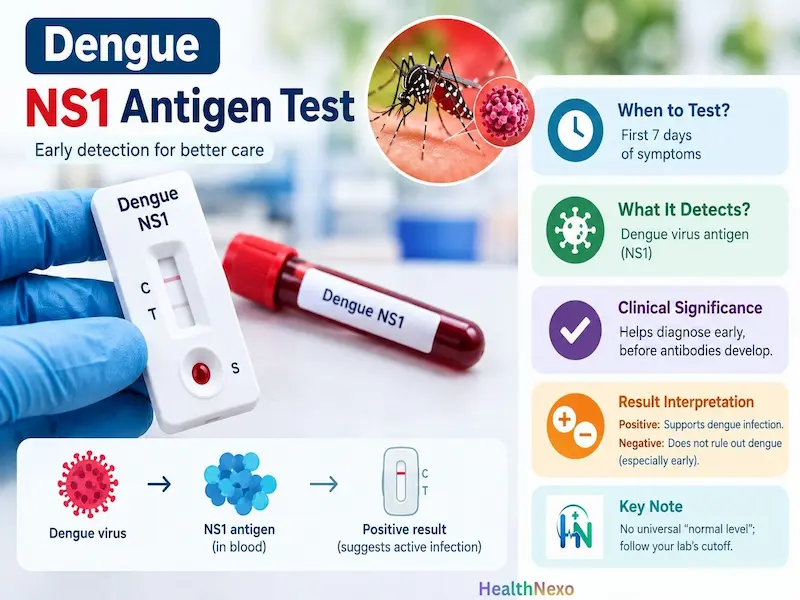
NS1 tests are generally qualitative. There is therefore no universal numerical “normal NS1 level”; results should be interpreted according to the laboratory’s assay-specific cutoff.
2. Dengue NAAT / RT-PCR
Nucleic acid amplification tests such as RT-PCR identify dengue virus RNA directly. The viral RNA is most effective in identification within the first 7 days of onset, thus the importance of molecular tests during the acute phase.
Clinical Significance
The presence of a positive NAAT indicates the molecular detection of dengue virus infection. Certain molecular tests are also able to detect the specific dengue serotype, but this kind of information is more valuable for surveillance and epidemiology studies than clinical treatment of patients. After 7 days, it becomes less likely to detect the RNA of the virus; therefore, the usefulness of molecular diagnostics decreases.
Result interpretation:
- Positive: Confirms current dengue virus infection.
- Negative: Does not completely exclude dengue.
NAAT is generally reported qualitatively, so there is no universal numerical “normal RT-PCR value.”
3. Dengue IgM Antibody Test
Anti-IgM antibodies form as the body reacts to a dengue infection. Dengue IgM usually becomes detectable around 4–5 days after symptom onset and can remain detectable for several weeks to months.
Clinical Significance
IgM is progressively more useful during the acute phase. During the first 7 days of illness, CDC recommends using an IgM test together with either NAAT or an NS1 antigen test when testing for acute dengue.
Result interpretation:
- Positive: Supports recent dengue infection.
- Negative: May occur when testing is performed before IgM becomes detectable.
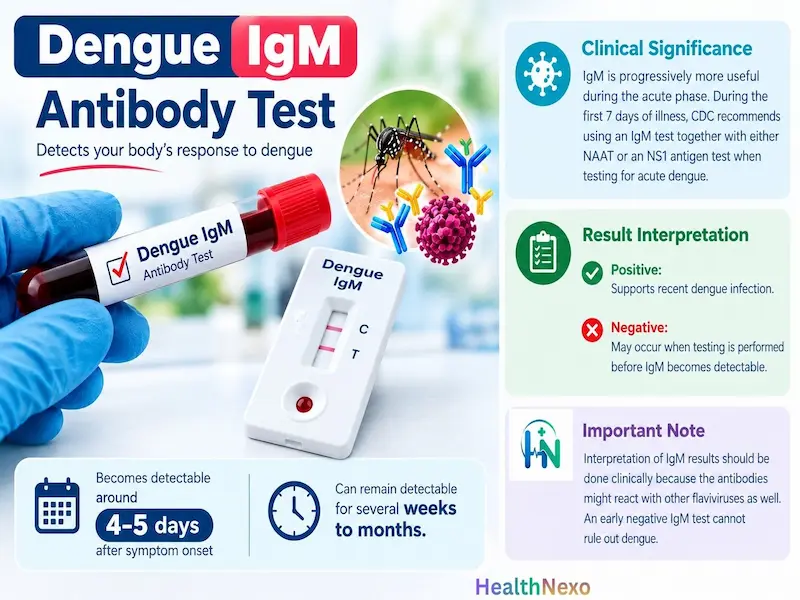
Interpretation of IgM results should be done clinically because the antibodies might react with other flaviviruses as well. An early negative IgM test cannot rule out dengue.
4. Dengue IgG Antibody Test
The IgG antibody remains in the body for a much longer period compared to IgM. One positive result for IgG can be an indication of either past infection with dengue or related flavivirus.
Clinical Significance
Therefore, a single measurement of IgG is not enough for diagnosis of acute dengue. However, there are certain situations where serological confirmation by means of paired sera which exhibit seroconversion or marked increase in antibodies could be more helpful. Convalescent sera might be used when the first test proves inconclusive.
Result interpretation:
- Negative: Dengue IgG not detected.
- Positive: Dengue IgG detected above the assay’s cutoff.
5. CBC, Platelets and Hematocrit in Dengue
A complete blood count (CBC) is useful for supportive assessment and monitoring, but it is not a dengue-specific diagnostic test.
Common laboratory changes include:
- Leukopenia: A reduced white blood cell count can occur during dengue.
- Thrombocytopenia: Platelet counts may fall as the illness progresses.
- Rising hematocrit: An increasing hematocrit may indicate hemoconcentration associated with plasma leakage.
White Blood Cell Count
A typical adult WBC reference range is approximately 4,000–11,000 cells/µL, although ranges vary by laboratory. Leukopenia can occur in dengue but is not specific to the infection.
Platelet Count
A typical adult platelet count is about 150,000–450,000 platelets/µL, although reference ranges may vary by laboratory. With dengue fever, the platelet count reduces through the disease progression, but a low platelet count does not necessarily imply the presence of dengue fever, since it may be due to any other cause. However, a high platelet count does not exclude the presence of dengue fever.
Hematocrit
Hematocrit determines the amount of blood volume occupied by red blood cells. A rising hematocrit may indicate hemoconcentration associated with plasma leakage, particularly when it occurs with clinical warning signs. Dehydration, hemorrhage, intravenous therapy, and personal differences are other factors that influence hematocrit. It must therefore be analyzed in conjunction with the changes in platelet count. Lab-specific normal ranges must supersede general ranges.
Dengue Blood Tests by Day of Illness
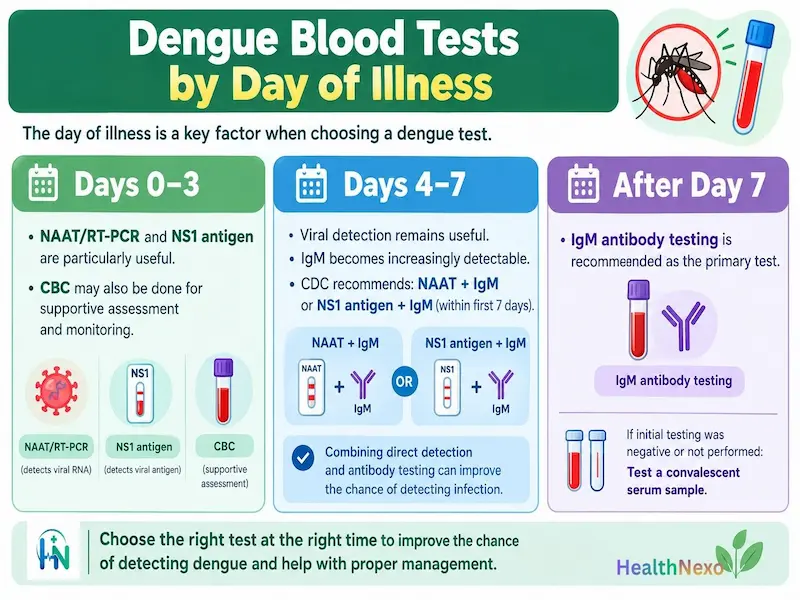
The day of illness is a key factor when choosing a dengue test.
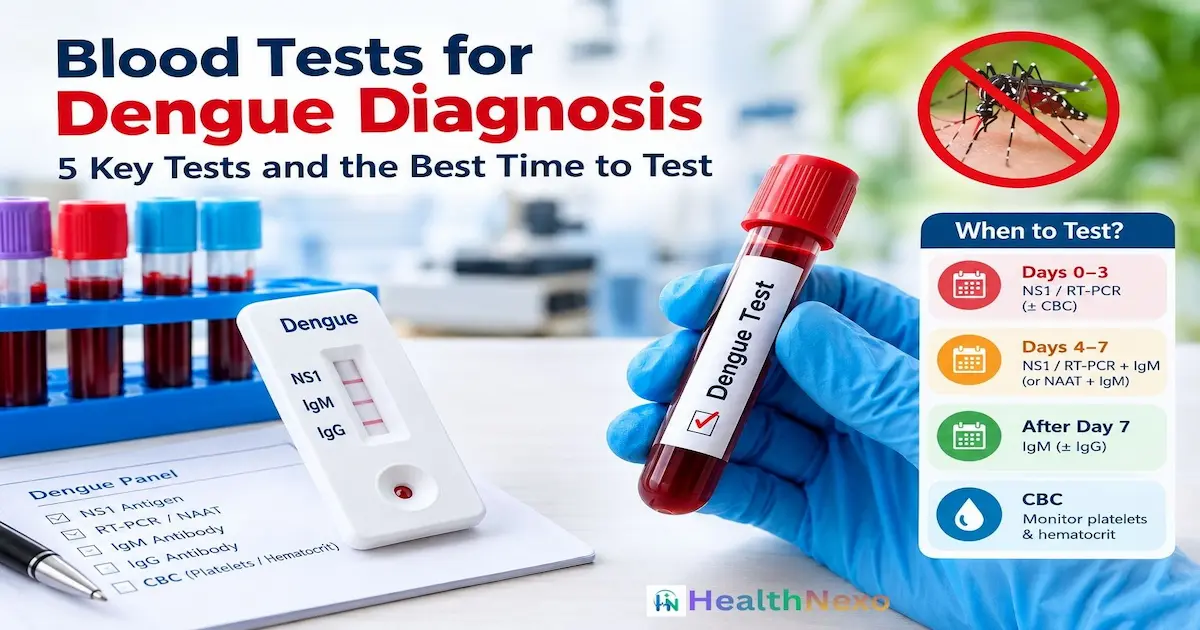
Days 0–3
NAAT/RT-PCR and NS1 antigen are particularly useful during this early period because they detect viral components during the acute phase. CBC may also be performed for supportive assessment and monitoring.
Days 4–7
Viral detection remains useful during this period, while dengue IgM becomes increasingly detectable. During the first 7 days of illness, CDC recommends testing with either NAAT plus IgM or NS1 antigen plus IgM.
- NAAT + IgM
- NS1 antigen + IgM
This approach combines direct detection of dengue virus or its antigen with antibody testing, which can improve the chance of detecting infection during the acute phase.
After Day 7
After day 7 of illness, IgM antibody testing is recommended as the primary test. If the initial acute-phase testing was negative or was not performed, a convalescent serum sample may be tested.
There may be different approaches to the test depending on the method used, the sample collected, exposure to dengue or other flaviviruses previously, and other factors. WHO suggests varying the testing technique according to the stage of infection and the clinical situation.
Why a Negative Dengue Test Does Not Always Rule Out Infection
The negative test result should be considered in conjunction with the time the blood specimen was taken. For instance, an IgM test conducted at an early stage may come out negative because the antibodies are not yet available in sufficient numbers. In contrast, the NAAT test becomes less reliable in later stages of the disease due to a reduced amount of RNA. NS1 test results may also depend on the day of illness and prior infection. Therefore a negative dengue test does not automatically exclude dengue.
Clinicians consider:
- Day of illness + test used + symptoms + exposure risk + previous infection + follow-up testing when appropriate
Repeat Testing and Convalescent Samples
Repeat testing may be considered when:
- The initial sample was collected very early.
- NS1 or NAAT was negative, but clinical suspicion remains high.
- IgM was negative before antibodies were expected to become detectable.
- The illness has entered a different diagnostic phase.
- A second sample is needed to demonstrate antibody development.
Negative results from early NS1 and IgM tests prompt CDC to state that in such a case, the follow-up specimen could undergo IgM testing when needed. According to WHO’s 2025 guidelines, serum follow-up tests will be conducted when the initial results are inconclusive. Repeat testing would be required based on the patient’s symptoms, day of illness, initial test results, and clinical evaluation.
CBC Monitoring and Clinical Significance
Dengue can evolve very quickly, especially when the patient begins to come down from the fever. Laboratory testing may assist in identifying signs of evolution to the critical stage.
One clinically important pattern is:
- Falling platelets + rising hematocrit + clinical warning signs
This can point to hemoconcentration due to leakage of plasma. It should not be considered a diagnostic equation but only for informational purposes.
Dengue Warning Signs
Laboratory results should always be interpreted together with clinical symptoms. Important dengue warning signs include:
- Severe abdominal pain or tenderness
- Persistent vomiting
- Clinical fluid accumulation
- Bleeding from the nose or gums
- Vomiting blood or blood in the stool
- Marked drowsiness, irritability, or restlessness
- Liver enlargement
- Progressive increase in hematocrit
These findings are particularly important around the time of defervescence, when dengue can enter the critical phase. Severe dengue can be associated with severe plasma leakage leading to shock or respiratory distress, bleeding or organ dysfunction. Once the critical phase has passed, appropriate dengue recovery and home care can help support recovery.
Bottom Line
Blood Tests for Dengue Diagnosis are most useful when interpreted according to the day of illness. NS1 and NAAT/RT-PCR are particularly useful during the first 7 days, while IgM becomes increasingly useful as the illness progresses. CBC, platelet count, and hematocrit can help monitor changes during illness but cannot confirm dengue on their own.
Reliable interpretation combines: Symptoms + illness day + dengue-specific testing + CBC/hematocrit trends + clinical assessment
If dengue remains suspected after a negative result, follow-up testing may be needed based on the timing and type of test.
Frequently Asked Questions (FAQs)
Q1. What is the most useful blood test for dengue?
The answer depends on the day of illness. During the first 7 days, NAAT/RT-PCR or NS1 combined with IgM is recommended for acute dengue evaluation. After day 7, IgM becomes increasingly important.
Q2. Can a normal platelet count rule out dengue?
No. Platelets may remain normal early in infection. Platelet counts are mainly used to track changes during dengue illness and should be considered alongside symptoms and other laboratory results.
Q3. Can a negative NS1 test rule out dengue?
No. A negative NS1 result does not completely exclude dengue. Timing, previous infection, and assay performance can influence detection.
Q4. When does dengue IgM become positive?
Dengue IgM can become detectable after about 3 days of illness and is increasingly useful as the illness progresses. It may remain detectable for approximately 3 months.
Q5. Why is hematocrit monitored in dengue?
An increase in the level of hematocrit indicates hemoconcentration that is linked to plasma loss. The detection of such an abnormality, together with the platelet count and symptoms of warning, may help detect individuals at risk.
Medical Disclaimer
The purpose of this article is to provide basic information that cannot substitute for professional evaluation of a case by a physician. Interpretation of the results of a dengue test depends on many factors, including the day of illness, symptoms, prior dengue infection or exposure to similar flavivirus, the sample type used, and other criteria.
References
- Centers for Disease Control and Prevention (CDC). Clinical Testing Guidance for Dengue. Updated August 26, 2025. CDC Clinical Testing Guidance for Dengue
- Centers for Disease Control and Prevention (CDC). NS1 Antigen Tests for Dengue Virus. Updated September 8, 2025. CDC NS1 Antigen Tests for Dengue Virus
- Centers for Disease Control and Prevention (CDC). Molecular Tests for Dengue Virus. Updated August 22, 2025. CDC Molecular Tests for Dengue Virus
- Centers for Disease Control and Prevention (CDC). Serologic Tests for Dengue Virus. Updated September 8, 2025. CDC Serologic Tests for Dengue Virus
- World Health Organization (WHO). Laboratory Testing for Dengue Virus: Interim Guidance. April 2025. WHO Laboratory Testing for Dengue Virus: Interim Guidance
- Centers for Disease Control and Prevention (CDC). Clinical Care of Dengue. Updated April 15, 2026. CDC Clinical Care of Dengue
- Centers for Disease Control and Prevention (CDC). Clinical Signs and Symptoms of Dengue. Updated February 24, 2026. CDC Clinical Signs and Symptoms of Dengue
Tags:

Md. Rakibul Hasan, BSc (Hons), MS (Thesis)
Biochemistry & Molecular Biology, University of Chittagong, Bangladesh
Senior Biochemist | Health Content Writer | Evidence-Informed Health Information Creator
Popular Diagnostic Centre Limited, Bangladesh.
He specializes in clinical biochemistry, laboratory diagnostics, and medical testing. Alongside his professional work, he is actively involved in health education and scientific communication.
As a Health Content Writer and Research-Based Health Information Creator, he simplifies complex medical and biochemical topics into clear, evidence-informed, and reader-friendly health information.