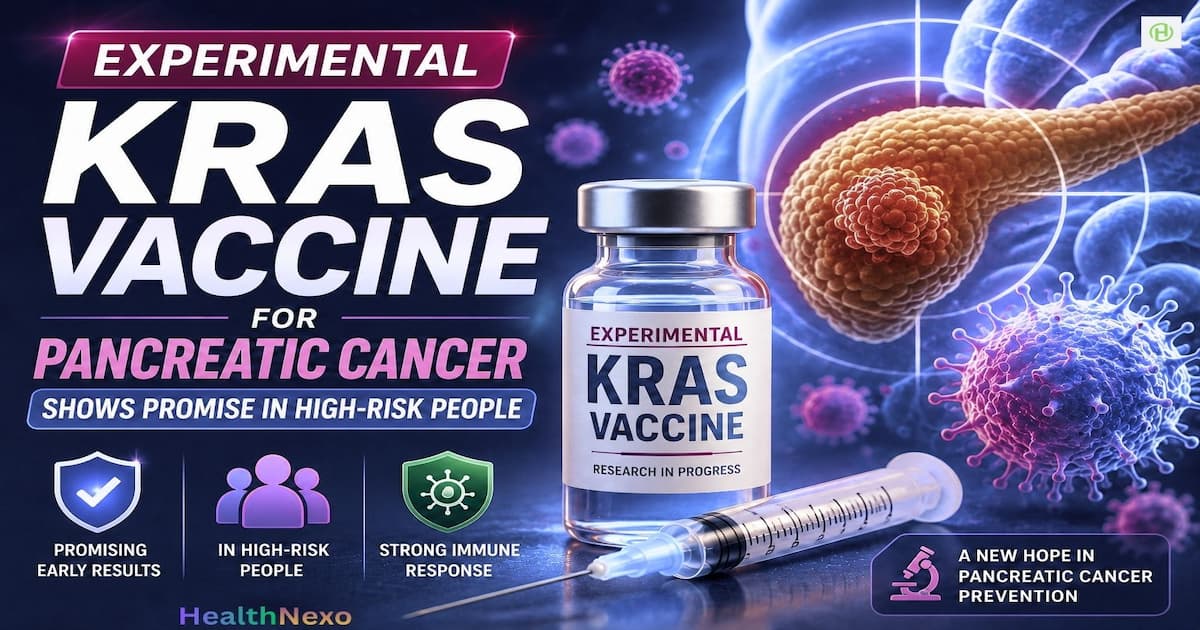
The experimental KRAS vaccine for pancreatic cancer, called mKRAS-VAX, has produced encouraging preliminary results in its first human trial. The vaccine called mKRAS-VAX has been tried out on those people who were likely to develop pancreatic cancer. It has been found that the vaccine produced a strong immune response and was well-tolerated by patients. The results of the study were presented at the AACR Annual Meeting 2026. The study has also been published in Cancer Discovery journal.
However, the vaccine is only experimental at present. Scientists say more clinical trials are needed to confirm whether the vaccine can help treat or prevent pancreatic cancer.
Global Statistics on Pancreatic Cancer
Pancreatic cancer is a highly aggressive cancer with a poor survival rate. Pancreatic cancer is challenging to diagnose because the symptoms may become noticeable only when it is already too late to treat the cancer. As a result, there is little that can be done to combat this type of cancer. WHO/IARC mentions that:
- More than 510,000 people get a diagnosis of pancreatic cancer every year.
- More than 467,000 people die from this disease yearly.
The most common type of pancreatic cancer is Pancreatic Ductal Adenocarcinoma (PDAC), which accounts for 90–95% of all the cases. In over 90% of PDAC cases, the gene associated with KRAS is mutated. KRAS mutations appear early in pancreatic cancer development, making them a promising target for cancer prevention.
Why Researchers Are Targeting KRAS
KRAS is one of the genes that regulate cell division. When this gene mutates, cells can begin to grow and divide uncontrollably. Cancer may eventually develop due to such an abnormality. In cases of pancreatic cancer, KRAS mutations are detected way before a tumor develops, giving scientists a chance to act at the earliest stage possible.
Scientists hope the experimental KRAS vaccine for pancreatic cancer will train the immune system to recognize and destroy abnormal cells before they develop into cancer. This preventive approach is known as cancer interception.
What is mKRAS-VAX?
mKRAS-VAX is a peptide therapeutic vaccine that is currently under development for the treatment of KRAS mutations in pancreatic cancers. The vaccine is designed to target six common KRAS mutations found in pancreatic ductal adenocarcinoma (PDAC). Poly-ICLC is another ingredient of mKRAS-VAX, which is known to stimulate the immune system. It facilitates the development of a T-cell response against KRAS mutant cells.
Whereas other methods target a pre-existing tumor, mKRAS-VAX will work on helping the body’s immune system recognize and destroy abnormal cells before a tumor can form. However, the vaccine is still under testing and not available for regular clinical use.
How the KRAS Vaccine Works
Whereas vaccines provide protection from infectious diseases, the mKRAS-VAX vaccine specifically targets mutations in cancer-associated KRAS. It teaches the body’s immune system to recognize and destroy cancerous cells. Post-vaccination, the immune system:
- Recognizes cells with KRAS mutations
- Activates CD4+ helper T cells
- Activates CD8+ cytotoxic T cells
- Helps destroy abnormal cells before tumors form
Scientists think that this immune reaction may decrease the chances of developing pancreatic cancer in those who are susceptible to it. But more studies have to be done before one can say for sure that this vaccine prevents cancer.
Phase 1 Clinical Trial Design
This was the first human clinical trial of mKRAS-VAX. The Phase 1 study included 20 adults who were considered to be at high risk of developing pancreatic cancer. Participants were considered high risk because they had one or more of the following:
- A strong family history of pancreatic cancer
- Inherited gene mutations linked to pancreatic cancer
- Precancerous pancreatic cysts or lesions
- Other inherited conditions that increase pancreatic cancer risk
Each participant received mKRAS-VAX with poly-ICLC. The Phase 1 trial focused on safety and immune response, not on proving that the vaccine prevents pancreatic cancer.
Key Scientific Findings
The Phase 1 trial showed encouraging early results. Researchers found that:
- 18 of 20 participants (90%) developed a KRAS-specific T-cell response.
- The immune response lasted for several months.
None of the participants in this study got pancreatic cancer during the follow-up period, which lasted for 16.5 months on average. No serious treatment-related side effects were reported.
Some common side effects included:
- Intramuscular pain
- Fatigue
- Headache
- Symptoms similar to the flu
Scientists have noted these preliminary results as encouraging, but larger clinical trials involving Phases 2 and 3 are required to establish the safety and efficacy of the vaccine.
What Do These Findings Mean?
This research shows that mKRAS-VAX may stimulate an immune reaction in people who are at a high risk of developing pancreatic cancer. Nonetheless, the vaccine is still experimental.
The study showed that:
- mKRAS-VAX activated KRAS-specific T cells.
- These immune cells could assist in destroying abnormal cells.
- The Phase 1 trial focused on evaluating the vaccine’s safety and immune response.
- This trial was not designed to show that the vaccine prevents pancreatic cancer.
Additional information:
- The number of patients in this trial was limited (only 20 patients).
- No control group was involved.
- Further clinical trials will be required to determine the effectiveness of this vaccine.
In case the future research proves the effectiveness of the vaccine, it could be a good choice for people at risk of developing pancreatic cancer.
Who Could Benefit?
If the vaccine proves to be effective in further clinical studies, it could prove to be useful for individuals who have an increased risk of developing pancreatic cancer. These individuals may include people with:
- Family history of pancreatic cancer
- Gene mutations like BRCA2, CDKN2A, PALB2, ATM, or STK11
- Inherited predisposition to cancer
- Precancerous pancreatic lesions
Study Limitations
The Phase 1 trial showed promising early results. However, the study had several important limitations.
Key limitations include:
- A total of only 20 patients participated.
- The median follow-up time was 16.5 months.
- The study lacked any placebo and control groups.
The study was concerned with the safety and immunogenicity aspects, not with the proof of efficacy against pancreatic cancer. Due to the mentioned limitations, the results are preliminary and need to be confirmed in larger studies.
Future Research of KRAS Vaccine for Pancreatic Cancer
Further research is expected to proceed in Phase 2 and Phase 3 clinical trials of mKRAS-VAX. Such trials would help to reveal the effect of the vaccine and its potential to lower pancreatic cancer risk.
Such further research would include:
- Testing the vaccine in more patients
- Determining the duration of immunity provided by the vaccine
- Finding out whether booster shots are required
- Creating vaccines targeting KRAS that would be useful against colorectal and lung cancer
If further research proves to be positive, KRAS-targeted vaccines could become a new prevention method for high-risk individuals.
Why This Research Matters
Pancreatic cancer is among the deadliest cancers. Most cases are usually detected late in their course when they are harder to treat. In comparison, mKRAS-VAX is a unique technique that is geared towards:
- Training the body’s immune system to detect mutated KRAS
- Prevent the development of abnormal cells into cancer cells
- Ensure that patients who are highly susceptible to pancreatic cancer are protected
- Clinical trials will be conducted in the future to validate whether the vaccine can help prevent pancreatic cancer.
Currently, mKRAS-VAX is just under clinical trials and has not yet been approved for clinical use.
Key Takeaway
The experimental KRAS vaccine for pancreatic cancer, known as mKRAS-VAX, has been evaluated in a Phase 1 clinical trial. The study involved people at high risk of developing pancreatic cancer to assess the vaccine’s safety and immune response. This vaccine was found to trigger a specific T-cell reaction against KRAS in 90% of the participants while being well-tolerated among them. Nevertheless, the objective of the study was not to prove the effectiveness of the vaccine but rather its safety and immune response.
Frequently Asked Questions (FAQs)
Q1. Can the KRAS vaccine prevent pancreatic cancer?
No. The current Phase 1 study only evaluated safety and immune response. Larger trials are needed to determine whether it can prevent pancreatic cancer.
Q2. Who might be eligible for the KRAS vaccine in the future?
If future trials are successful, it may be considered for people at high risk, including those with inherited genetic mutations or a strong family history.
Q3. Is mKRAS-VAX approved for public use?
No. It remains an experimental vaccine undergoing clinical trials.
Q4. What makes KRAS an important target?
KRAS mutations occur in more than 90% of pancreatic ductal adenocarcinomas and often appear before cancer develops, making them a potential target for early intervention.
References
- American Association for Cancer Research (AACR). AACR Annual Meeting 2026.
- Cancer Discovery. Therapeutic KRAS Vaccination in Patients With Pancreatic Cancer: A First-in-Human Phase I Trial.
- World Health Organization (WHO).
- International Agency for Research on Cancer (IARC).
 Medical Disclaimer
 Medical Disclaimer
The information provided in this article is for educational and informational purposes only. It is not intended to be a substitute for professional medical advice, diagnosis, or treatment. Always consult a qualified healthcare professional before making any medical decisions, starting any treatment, or changing your current healthcare plan.

Md. Rakibul Hasan, BSc (Hons), MS (Thesis)
Biochemistry & Molecular Biology, University of Chittagong, Bangladesh
Senior Biochemist | Health Content Writer | Evidence-Informed Health Information Creator
Popular Diagnostic Centre Limited, Bangladesh.
He specializes in clinical biochemistry, laboratory diagnostics, and medical testing. Alongside his professional work, he is actively involved in health education and scientific communication.
As a Health Content Writer and Research-Based Health Information Creator, he simplifies complex medical and biochemical topics into clear, evidence-informed, and reader-friendly health information.