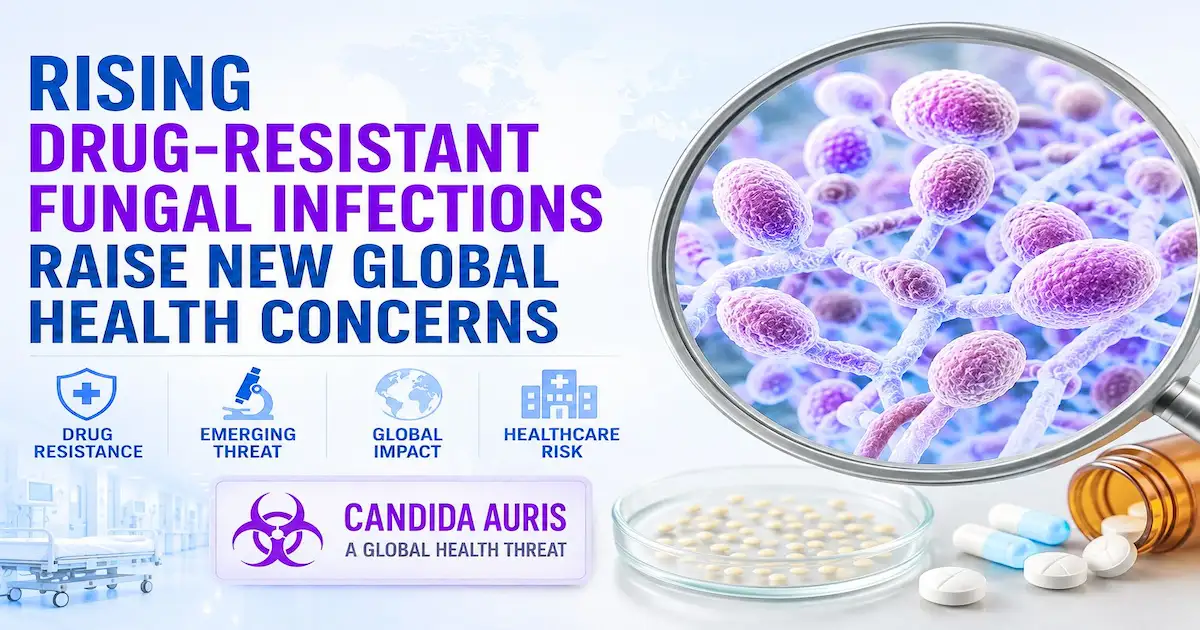
Drug-resistant fungal infections are raising global health concerns, with Candida auris remaining a major threat in healthcare settings. The fungus can spread between patients, persist on skin and surfaces, and develop resistance to commonly used antifungal medicines. Recent U.S. surveillance and genomic research are providing new insights into its continued spread and antifungal resistance.
This article explains how Candida auris spreads, develops antifungal resistance, who is most at risk, and what health authorities are doing to control it.
Key Takeaways
- Candida auris is a drug-resistant fungus that can spread in healthcare settings.
- Some strains are resistant to multiple antifungal medicines, making treatment more difficult.
- U.S. surveillance shows that clinical cases have continued to occur, although the rate of increase has slowed in recent years.
- Recent genomic research identified FKS1 hotspot mutations in 49 of 53 echinocandin-resistant isolates studied.
- Early detection, antifungal susceptibility testing, genomic surveillance, and strong infection-control measures are important for limiting transmission.
What Is Candida auris?
Candida auris is a type of yeast that is becoming a growing health concern. It can live on the skin without causing symptoms or causing serious infections in some people. It can cause infections in the:
- Bloodstream
- Wounds
- Ears
- Other parts of the body
Serious Candida auris infections are more common in people who are already very ill or receiving intensive medical care. Unlike many other Candida species, C. auris can remain on the skin and survive on healthcare surfaces for long periods, allowing it to spread between patients and cause healthcare-associated outbreaks.
Why Drug-Resistant Fungal Infections Are Concerning
Some C. auris strains can develop resistance to multiple classes of antifungal medicines. This can:
- Reduce available treatment options
- Make infections more difficult to manage
- Increase the risk of treatment failure
- Complicate outbreak control
- Create additional challenges for healthcare systems
The WHO lists C. auris as a critical-priority fungal pathogen. This is because it can cause serious infections, spread in healthcare settings, and become resistant to antifungal medicines.
How Does Candida auris Develop Antifungal Resistance?
The development of antifungal resistance in C. auris can involve genetic and cellular mechanisms that reduce the effectiveness of medicines.
FKS1 Mutations
- The FKS1 gene encodes part of the target of echinocandin antifungal drugs.
- Certain hotspot mutations can alter this target and reduce susceptibility to echinocandins.
A CDC-led study published in 2026 found FKS1 hotspot mutations in 49 of 53 echinocandin-resistant isolates. This means that about 92% of these resistant isolates had these mutations.
Drug Efflux
- Fungal cells can contain proteins known as efflux pumps.
- These pumps can push some antifungal drugs out of fungal cells.
- This can lower the amount of the drug inside the cells and make the treatment less effective.
ERG11 Modifications
- Azole antifungal medicines interfere with ergosterol production.
- Ergosterol helps keep fungal cell membranes stable and functioning properly.
Changes in the ERG11 gene can affect how azole medicines work. This may make C. auris less sensitive to some azole antifungal drugs.
Biofilm Formation
- Auris can form biofilms on surfaces and medical devices.
- Biofilms can help C. auris survive in healthcare environments.
- They may also make the fungus harder to treat and less affected by environmental conditions.
Simple Mechanism of Antifungal Resistance
- Antifungal exposure → genetic or cellular changes → altered drug targets or increased drug efflux → reduced drug activity → fungal survival → resistance
U.S. Surveillance Shows Continued Candida auris Activity
- U.S. surveillance shows that C. auris remains an important healthcare-associated pathogen.
- According to CDC surveillance data, 6,304 clinical cases were reported in the United States in 2024, compared with 4,523 in 2023 and 2,915 in 2022.
- According to the CDC, since the first U.S. case was reported in 2016, the number of reported clinical cases of Candida auris has continued to rise. However, the pace of increase has slowed in recent years, particularly since 2022.
Clinical cases represent people with infection or disease. Screening can also identify people who are colonized with C. auris without showing signs of active infection. This is important because people who carry C. auris may spread the fungus even without symptoms.
What Genomic Research Reveals About Candida auris
Genomic surveillance provides information that cannot be obtained from routine case counting alone. A 2026 CDC-led genomic study analyzed 1,535 U.S. C. auris isolates collected from 2013 to 2022. Researchers examined genetic differences among isolates and investigated characteristics associated with antifungal resistance.
Among 809 isolates that underwent antifungal susceptibility testing:
- 53 were resistant to echinocandins
- 49 of those 53 resistant isolates had FKS1 hotspot mutations
- This represented 92% of the echinocandin-resistant isolates
Genomic surveillance can help scientists understand:
- How closely related different strains are
- How the fungus is spreading
- Where transmission may be occurring
- Which genetic changes are associated with resistance?
- How resistant strains may emerge and spread
How Does Candida auris Spread?
Auris can spread through contact with contaminated people, surfaces, equipment, and healthcare environments. Potential sources include:
- Hands of healthcare workers
- Medical equipment
- Medical devices
- Bed rails
- Frequently touched surfaces
- Patient-care areas
- Other contaminated environmental surfaces
- The organism can survive on the skin and persist in the environment.
For this reason, controlling C. auris requires more than treating infected patients. Environmental cleaning, hand hygiene, appropriate protective equipment, screening, and infection-control practices are also important.
Who Has a Higher Risk of Candida auris Infection?
Most healthy people are not at high risk of developing serious illness from C. auris. The risk is higher among people who have extensive exposure to healthcare settings. Higher-risk groups include people who:
- Have prolonged hospital stays
- Live in long-term care facilities
- Have weakened immune systems
- Use invasive medical devices
- Require intensive care
- Have undergone major medical procedures
- Have received substantial antimicrobial treatment
Serious invasive infection can occur when C. auris enters normally sterile sites, such as the bloodstream.
Why Candida auris Is a Global Health Concern
The concern extends beyond the United States.
- The WHO has placed Candida auris in its critical-priority category of fungal pathogens. WHO gave Candida auris this classification because it can cause serious infections. It can also spread in healthcare settings and resist antifungal medicines.
- Many countries still face challenges in detecting and tracking fungal infections.
- In June 2026, WHO released a new plan to improve the response to fungal diseases and antifungal resistance. The plan focuses on better testing, monitoring, prevention, and treatment.
What Are Health Authorities Doing?
Health authorities are using several strategies to address the growing threat of drug-resistant fungal infections.
- Early Detection: Rapid identification of C. auris can help healthcare facilities implement infection-control measures and reduce further transmission.
- Antifungal Susceptibility Testing: Laboratory testing can help determine whether a C. auris isolate is susceptible or resistant to available antifungal medicines. This information can help clinicians select appropriate treatment.
- Genomic Surveillance: Genomic sequencing helps scientists track how the fungus spreads. It can also reveal genetic changes linked to antifungal resistance.
Infection Prevention and Control
Important measures include:
- Hand hygiene
- Appropriate personal protective equipment
- Environmental cleaning
- Disinfection of healthcare equipment
- Screening when appropriate
- Isolation or other infection-control measures when indicated
Development of New Treatments
- Researchers continue to investigate new antifungal medicines, treatment strategies, and diagnostic tools.
- This is important because treatment options for some drug-resistant fungal infections remain limited.
What Do Drug-Resistant Fungal Infections Mean for the Public?
The emergence of Candida auris does not mean that every healthy person is at immediate risk. The highest risk is among people who are seriously ill or medically vulnerable. People with frequent exposure to healthcare settings may also face a higher risk. For the public, basic infection-prevention practices remain important.
People should:
- Practice good hand hygiene
- Follow healthcare professionals’ instructions
- Avoid unnecessary use of antimicrobial medicines
- Never self-medicate with antifungal drugs
- Seek appropriate medical care for persistent or serious infections
- Healthcare facilities play a central role in detecting, treating, and preventing the spread of C. auris.
Bottom Line
Drug-resistant fungal infections are becoming an important global health concern, with Candida auris being a major example. Its ability to spread in healthcare settings and resist some antifungal medicines can make infections harder to treat. Recent research is helping scientists understand antifungal resistance, how C. auris spreads, and how resistant strains develop. Early detection, proper infection control, antifungal testing, and new treatments can help reduce the spread and impact of these infections.
References
- CDC. Candida auris: Tracking and Surveillance.
- CDC. Clinical Overview of Candida auris.
- CDC. Infection Control Guidance for Candida auris.
- CDC Emerging Infectious Diseases. Updated Genomic Epidemiologic Description of Candida auris. 2026.
- WHO. WHO Fungal Priority Pathogens List. 2022.
- WHO. Blueprint for Strengthening Responses to Fungal Disease and Antifungal Resistance. 2026.
⚕️ Medical Disclaimer
The information provided in this article is for educational and informational purposes only. It is not intended to be a substitute for professional medical advice, diagnosis, or treatment. Always consult a qualified healthcare professional before making any medical decisions, starting any treatment, or changing your current healthcare plan.
Tags:

Md. Rakibul Hasan, BSc (Hons), MS (Thesis)
Biochemistry & Molecular Biology, University of Chittagong, Bangladesh
Senior Biochemist | Health Content Writer | Evidence-Informed Health Information Creator
Popular Diagnostic Centre Limited, Bangladesh.
He specializes in clinical biochemistry, laboratory diagnostics, and medical testing. Alongside his professional work, he is actively involved in health education and scientific communication.
As a Health Content Writer and Research-Based Health Information Creator, he simplifies complex medical and biochemical topics into clear, evidence-informed, and reader-friendly health information.