
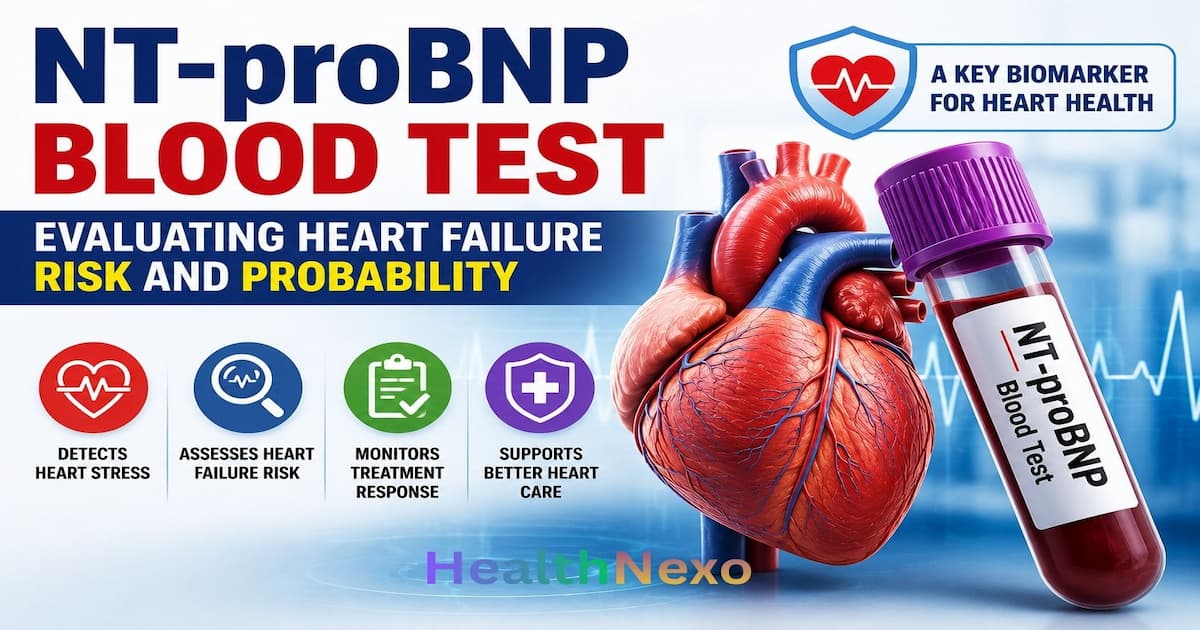
The NT-proBNP blood test is an important cardiac biomarker test for the present modern diagnosis system which is used to evaluate the stress of the heart and the risk of heart failure. This test is used by doctors in conjunction with other investigations, to assess heart function and aid in the diagnosis of heart disease, hopefully enabling prompt diagnosis of any problems.
Heart failure is when your heart cannot pump enough blood around your body as it should. Tests investigate how this condition affects the body (breathlessness, tiredness, leg swelling, tachycardia etc.).
Below, I have described in further detail how to perform a blood test for NT-proBNP for clinical evaluations to support early diagnosis, guide treatment decisions, and monitor heart function effectively.
Heart failure basics
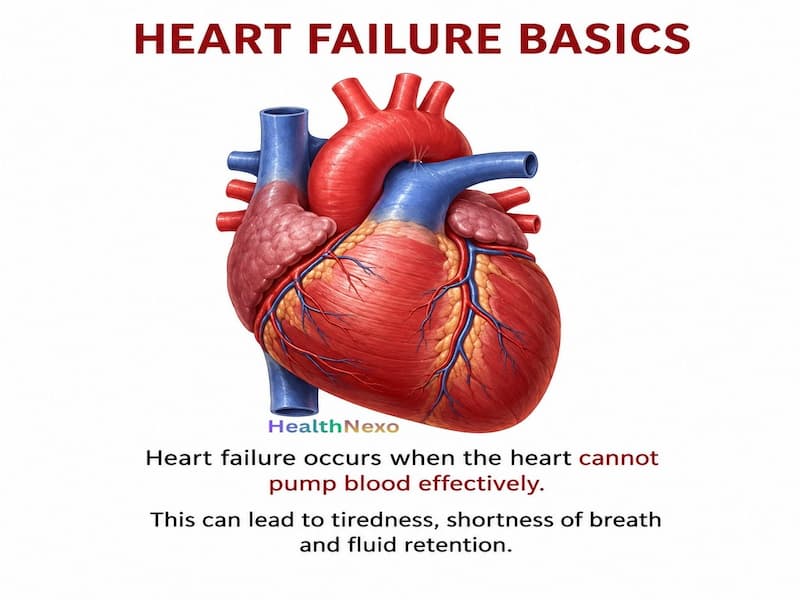
Heart Failure is when your heart does not pump blood around your body anymore. As your blood is not pumped round the body, the rest of your organs would not have received the appropriate amount of oxygen. As blood cannot be pumped round your body, you will experience fluid in the body all round your body.
The cause could be high blood pressure, heart attack or diabetes. The symptoms could be breathlessness, tiredness or edema of the legs. It will be much more suitable to begin treatment in the early stages of the condition as the disease will be easier to treat.
- Phase A: High risk but no heart damage or symptoms
- Phase B: Structural heart changes without symptoms
- Phase C: Symptoms present (shortness of breath, tiredness, oedema)
- Phase D: Severe symptoms even at rest, advanced condition
Cardiac function test
A Cardiac function test is carried out to assess the working of the heart and the pumping efficiency of the heart. In cardiac function tests, cardiac disease can be diagnosed with the help of cardiac function tests by a physician, screening, and tests for the test of working and functioning ability of the heart, life-threatening conditions like heart failure or heart attack.
- ECG : Evaluates the electrical activity of the heart, abnormal heart rhythms and detects the presence of heart attack.
- Echocardiogram (Echo test): an ultrasound imaging method used to visualize heart structures, their pumping action and value of the heart.
- TMT /Stress test: This test checks the performance of the heart while the patient performs a certain physical activity and detects underlying heart disease.
- NT-proBNP Blood Test: This test is used to diagnose stress in the heart, and it is very useful in assessing the heart failure risk.
- Troponin I test: This test diagnoses damage to the heart muscles and is mostly performed during a heart attack situation.
What is NT-proBNP?
NT-pro BNP stands for N-terminal pro-B-type Natriuretic Peptide. NT-pro BNP is produced by the heart during over-pressure states of the organ. When the pumping action of the heart does not seem to deliver blood efficiently, it releases two hormones. One of them is the BNP (B-type Natriuretic Peptide), which is the current hormone which influences blood pressure, etc.
NT-proBNP – an inactive fragment released at the same time it does not have any “action” within the body; however, it does have a longer half-life than BNP. It is more stable and therefore more useful in laboratory conditions.
What Does NT-proBNP measure?
- Indicates cardiac wall stress
- Helps detect possible heart failure
- Assists in monitoring treatment response
- Employed throughout worldwide ER and Cardiology units
As it has proved to be stable, valuable and reliable to diagnose heart failure.
Why Is the NT-proBNP Blood Test Done?
A doctor will consider using this cardiac marker test mainly when considering if symptoms are due to heart failure or other medical problem. The signs and symptoms of heart failure are similar to those associated with chest infections, lung disorders or kidney disorders and so these symptoms could not be diagnosed accurately without a lab test.
Common reasons for ordering the test include:
- Breathlessness on exertion or at rest
- Dyspnea on lying flat (Orthopnea)
- Fatigue or weakness
- Leg, ankle and abdominal swelling (Peripheral Edema)
- Chest tightness or pressure
- Fast or irregular pulse
- Sudden weight gain due to fluid retention
Clinical uses of NT-proBNP Blood Test:
- Diagnose or rule out heart failure
- Assess severity of heart dysfunction
- Guide emergency treatment decisions
- Monitor chronic heart failure progression
- Assess response to therapy
NT-proBNP can be a useful “quick check” test in the emergency department to sort out whether symptoms are cardiac in nature.
Who Should Take an NT-proBNP Test?
Your doctor may ask for this test if they think that you might have a problem with your heart. This test is particularly useful if you are suffering with one or more of the following symptoms: breathlessness; chest pain; ankle or leg swelling; fatigue or palpitation (feeling that your heart is beating in a funny way) because these can be symptoms of heart failure. It can also be useful in a person who is considered to be at risk of having a heart condition.
This group of people may include someone with high blood pressure, a person who suffers from diabetes or kidney disease, and elderly patients or those with a strong family history of heart disease. In patients with a diagnosis of heart failure, this test may also be used as a method of assessing treatment efficacy.
NT-proBNP Blood Test Procedure
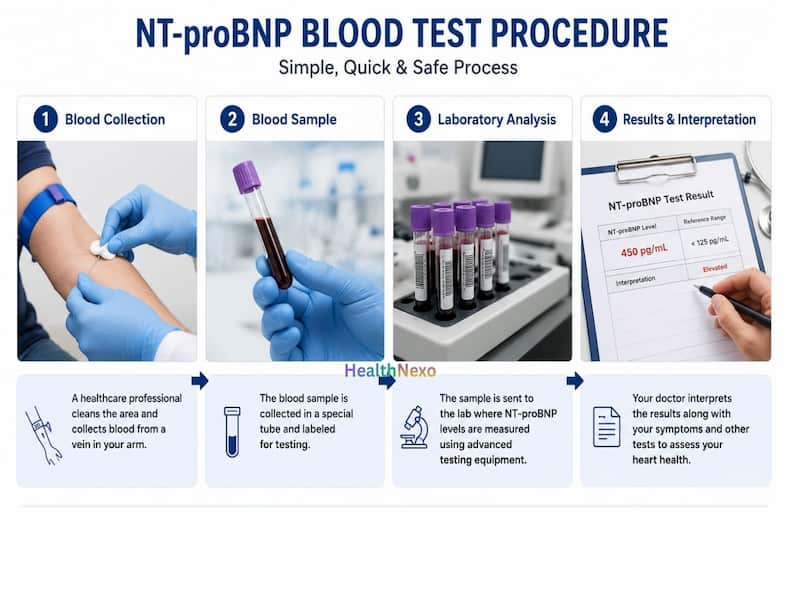
This test is an easy and fast test to monitor the heart. The blood test involves little preparation. NT-proBNP assay is commonly performed in a clinic or hospital.
Procedure:
- Your blood is drawn from a vein in your arm by a sterile needle.
- The blood is then sent to a lab for analysis of NT-proBNP levels (pg/mL).
- A doctor analyzes your blood results and uses them to assess the pressure within your heart and look for heart failure.
NT-proBNP level interpretation
The level of this cardiac marker test is determined by picograms per milliliter (pg/mL). Their interpretation depends on the age of the patient, the state of the kidneys, symptoms, and general health.
Below 125 pg/mL → Heart failure is less likely in most non-acute settings.
36–124 pg/mL → Low-normal range
125–299 pg/mL → Mild elevation; may need follow-up
300–449 pg/mL → Borderline; requires clinical evaluation
450–899 pg/mL → Elevated; possible heart failure
900–1,799 pg/mL → Strong suspicion of heart dysfunction
1,800–4,999 pg/mL → Marked elevation; likely heart failure
5,000–9,999 pg/mL → Severe elevation; advanced disease possible
10,000+ pg/mL → Critical condition; urgent evaluation required
NT-proBNP normal range by age
NT-proBNP levels rise physiologically with age, in the absence of any disease processes, thus age-adjusted thresholds are employed clinically.
Rule-out threshold (all ages):
- < 300 pg/mL → Heart failure unlikely
Rule-in thresholds:
- Under 50 years: > 450 pg/mL suggests heart failure
- 50–75 years: > 900 pg/mL increases suspicion
- Over 75 years: > 1,800 pg/mL strongly suggests heart failure
These values provide rapid assistance for doctors in making decisions.
Causes of elevated non-probnp levels
A high level does not always indicate heart failure. The other causes may include:
- Heart failure (most common cause)
- Heart attack (myocardial infarction)
- Atrial fibrillation
- Chronic kidney disease
- Pulmonary embolism
- Pulmonary hypertension
- Heart valve disease
- Cardiomyopathy
- Severe infection or sepsis
Because of this, the biomarker test must always be interpreted with clinical findings.
Factors That May Lower NT-proBNP
Some conditions can lead to lower-than-expected results:
- Obesity
- Certain heart failure medications
- Early stages of heart disease
This is important because a low value does not always completely exclude heart problems.
BNP vs NT-proBNP difference
1. Biological Activity
- BNP: Active hormone that affects fluid balance
- NT-proBNP: Inactive byproduct with no direct effect
2. Stability in Blood
- BNP: Breaks down faster, levels fluctuate more
- NT-proBNP: More stable, stays longer in circulation
3. Diagnostic Use
- BNP: Useful for immediate heart stress evaluation
- NT-proBNP: Better for diagnosis, screening, and monitoring
4. Measurement Reliability
- BNP: Can vary due to rapid metabolism
- NT-proBNP: More consistent and reliable in lab testing
5. Clinical Preference
- Many hospitals prefer NT-proBNP because it gives more stable results.
- BNP is still used but less common in many modern settings.
Key Takeaways
The NT-proBNP blood test has now become a crucial aspect of current medical practice. It provides an accurate and rapid assessment of stress on the heart and is a useful test in assessing the risk of heart failure, especially in a busy hospital ward where a quick and clear result is of importance.
Although very sensitive, it lacks specificity when considered alone, so it should not be considered diagnostic on its own but when interpreted in relation to other investigations and clinical findings.
The benefits of these conditions being diagnosed early and treated will also improve the patient’s quality of life and care received by such a person. If you are continuing to feel short of breath, are developing swollen legs or pain in the chest, and cannot explain your exhaustion, see your doctor for an assessment.
Frequently Asked Questions (FAQs)
Q1. When is the NT-proBNP level dangerous?
A dangerous NT-proBNP level is normally a greatly elevated levels from that expected in age. Very high concentrations (>900 pg/ml) may be suggestive of a possible cardiac failure. Critically elevated concentrations are a medical emergency.
Q2. Can NT-proBNP detect heart failure early?
Yes. A blood test called NT-proBNP blood test can indicate heart stress at an early stage and can assist in diagnosing heart failure before a person experiences obvious signs.
Q3. Can kidney disease raise NT-proBNP without heart failure?
Yes. Raised levels may be elevated in the setting of CCD (chronic kidney disease) as the impaired renal clearance of NT-proBNP from the blood.
Q4. Is fasting required before an NT-proBNP blood test?
No. Generally, fasting is not required before an NT-proBNP blood test, unless your physician wants to run other tests requiring fasting.
Q5. Does a normal NT-proBNP rule out heart problems?
No. A normal NT-proBNP level can largely exclude heart failure but cannot exclude all cardiac problems and is not the marker for all cardiac disease (arrhythmias, Coronary Artery disease etc.).
 Medical Disclaimer
 Medical Disclaimer
The information provided in this article is for educational and informational purposes only. It is not intended to be a substitute for professional medical advice, diagnosis, or treatment. Always consult a qualified healthcare professional before making any medical decisions, starting any treatment, or changing your current healthcare plan.

Md. Rakibul Hasan, BSc (Hons), MS (Thesis)
Biochemistry & Molecular Biology, University of Chittagong, Bangladesh
Senior Biochemist | Health Content Writer | Evidence-Informed Health Information Creator
Popular Diagnostic Centre Limited, Bangladesh.
He specializes in clinical biochemistry, laboratory diagnostics, and medical testing. Alongside his professional work, he is actively involved in health education and scientific communication.
As a Health Content Writer and Research-Based Health Information Creator, he simplifies complex medical and biochemical topics into clear, evidence-informed, and reader-friendly health information.


1 thought on “NT-proBNP Blood Test for Heart Failure: Risk Assessment and Diagnosis”