
Blood Tests for Female Fertility Problems can help identify hormonal imbalances that may affect ovulation and reproductive health. These tests assess different aspects of reproductive function, including ovarian reserve, ovulation, and hormone-related menstrual disorders. However, no single blood test can determine whether a woman can conceive naturally. The choice of tests depends on age, menstrual patterns, medical history, symptoms, and how long the woman has been trying to conceive.
This evidence-based guide explains seven commonly used hormone tests, their clinical purposes, how to interpret the results, and the limitations to consider.
Quick Summary
- AMH: Estimates ovarian reserve and helps predict ovarian response to stimulation during fertility treatment.
- FSH: Helps assess ovarian function and investigate certain causes of absent or irregular periods.
- LH: Helps evaluate ovulatory hormone patterns and investigate selected menstrual disorders.
- Progesterone: Can provide evidence of recent ovulation when measured at the appropriate time.
- Estradiol (E2): Helps interpret ovarian function, particularly alongside FSH.
- Prolactin: Is useful when symptoms or ovulatory disorders suggest elevated prolactin.
- TSH: Helps investigate thyroid dysfunction when clinical findings suggest a thyroid disorder.
Not every woman needs all seven tests. A complete fertility evaluation may also include pelvic ultrasound, fallopian tube assessment, and semen analysis.
When to Seek a Fertility Evaluation
The timing of a fertility evaluation depends on age, menstrual patterns, medical history, and how long a person has been trying to conceive. According to the American Society for Reproductive Medicine (ASRM), evaluation is generally recommended after:
- Under 35 years: 12 months of regular, unprotected intercourse without pregnancy.
- Age 35–40 years: 6 months without pregnancy.
- Over 40 years: More immediate evaluation may be appropriate.
Evaluation should not be delayed when there are irregular or absent periods, suspected endometriosis or fallopian tube problems, or other known conditions that may affect fertility. A healthcare professional can recommend appropriate investigations based on individual circumstances.
Irregular menstrual cycles can have several causes, including hormonal changes. Learn more about treatment options for irregular periods in teenage girls and when medical evaluation may be needed.
How Reproductive Hormones Affect Fertility
The term “hypothalamic-pituitary-ovarian axis” refers to the functioning of the hypothalamus, pituitary gland and ovaries. Hormones produced by the hypothalamus, pituitary gland, and ovaries work together to regulate follicular development, ovulation, and changes in the uterine lining.
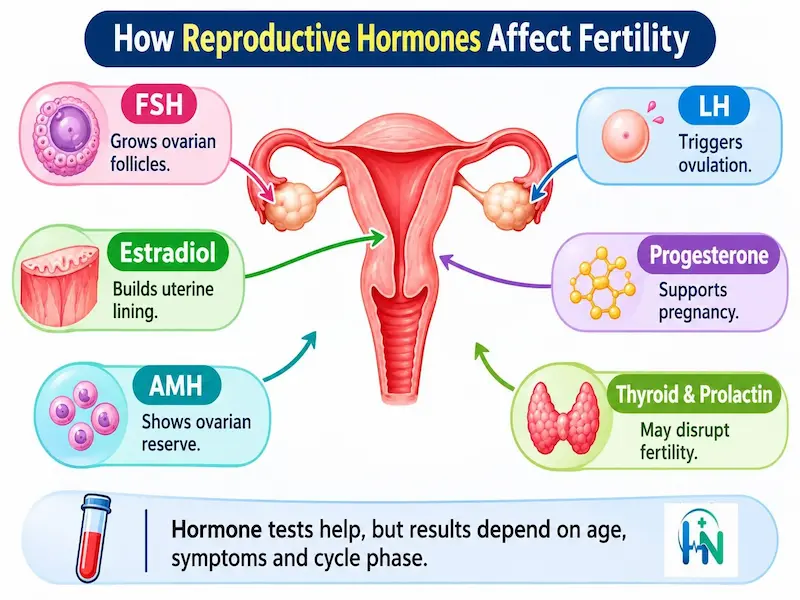
- FSH stimulates the development of ovarian follicles.
- LH forms peaks during mid-cycle and causes ovulation.
- Estradiol stimulates endometrium development and regulates reproductive hormone action.
- The level of progesterone increases after ovulation.
- AMH is produced by granulosa cells in small developing ovarian follicles and helps estimate ovarian reserve.
- Thyroid hormones and prolactin can disrupt the reproductive function of some women in the case of alterations in their levels.
Hormones tests can help to uncover certain problems, but they need to be interpreted in conjunction with clinical problem, age of the patient, symptoms, treatment scheme and cycle phase.
7 Blood Tests for Female Fertility Problems
Blood tests can help identify hormonal imbalances that may affect ovulation and female reproductive health. The seven tests below assess different aspects of fertility, including ovarian reserve, ovulation, and thyroid function. The appropriate tests depend on menstrual patterns, age, medical history, and individual symptoms.
1. Anti-Müllerian Hormone (AMH) Blood Test
AMH is produced by granulosa cells within small ovarian follicles. It indicates ovarian reserve and therefore reflects the number of developing follicles but does not indicate egg quality. AMH is a highly useful tool when deciding how to treat patients for fertility. It can provide information on how the patient will respond to ovarian stimulation. The 2026 NICE guidelines state that decisions on how the patient will respond during assisted conception treatments should be made, taking into consideration AMH or AFC.
However, it is not possible to predict clinical pregnancy through natural conception using AMH. Women who want to understand their reproductive options may also explore fertility preservation options for young women, including approaches that may help preserve future reproductive potential.
Reference Values and Interpretation
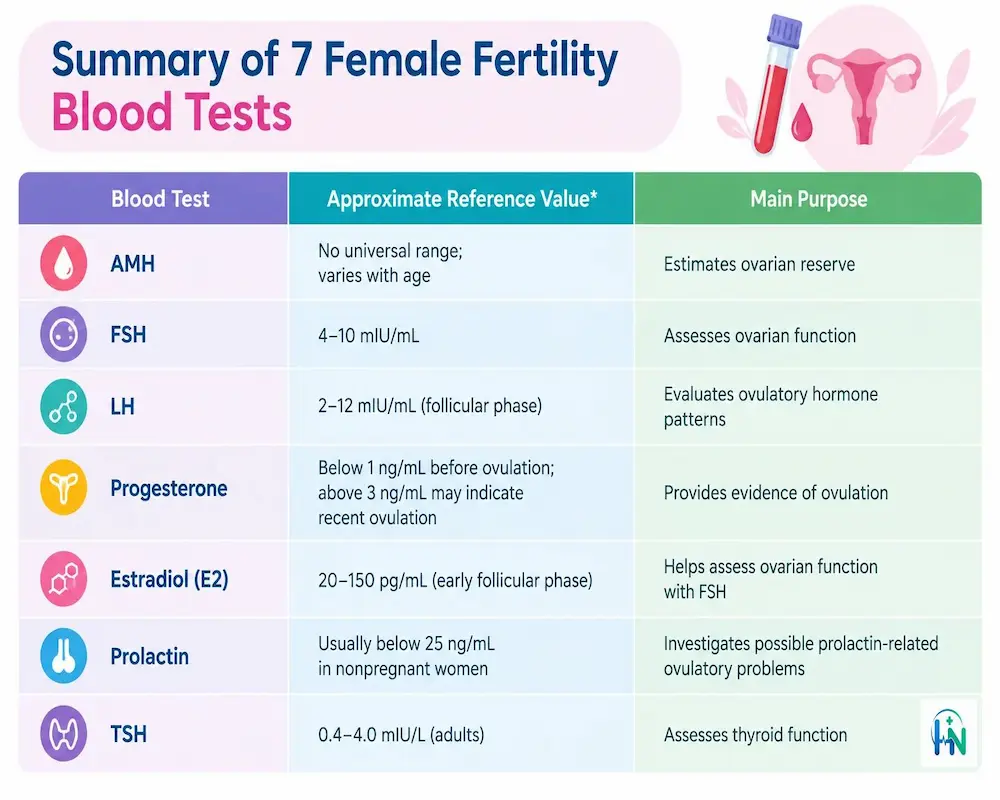
There is no single AMH level that is considered normal for every woman. Results vary with age and laboratory methods, so they should always be interpreted in the context of the patient’s overall health.
- Low AMH: May indicate a lower ovarian reserve and a reduced response to fertility treatment.
- High AMH: May reflect a higher number of small ovarian follicles and is sometimes seen in women with PCOS.
- Reference values: Levels around 1–4 ng/mL may be seen in some reproductive-age women, but this is not a universal range.
AMH helps estimate ovarian reserve and predict ovarian response during fertility treatment, particularly IVF. However, AMH alone cannot reliably predict the likelihood of natural conception or determine whether a woman is fertile or infertile.
2. Follicle-Stimulating Hormone (FSH) Blood Test
FSH is a hormone produced by the pituitary gland that stimulates ovarian follicle development. This test may be used to investigate absent or irregular menstrual periods and suspected ovarian dysfunction. FSH is often measured alongside estradiol during the early follicular phase of the menstrual cycle. Together, these hormone levels can help clinicians investigate whether menstrual disturbances may be related to ovarian dysfunction or problems involving the hypothalamus or pituitary gland.
Reference Values and Interpretation
FSH levels change with age and the menstrual cycle. Some laboratories use an early follicular-phase range of approximately 4–10 mIU/mL, but the reference range may differ between laboratories.
- High FSH: May suggest reduced ovarian reserve, particularly when considered alongside age and estradiol levels.
- High FSH with low estradiol: May indicate impaired ovarian function.
- Low or normal FSH with low estradiol: May point to a problem involving the hypothalamus or pituitary gland.
FSH can help identify ovarian problems and irregular periods when considered along with estradiol levels, age, and medical history. However, AMH and antral follicle count (AFC) are better for predicting how the ovaries may respond to fertility treatment.
3. Luteinizing Hormone (LH) Blood Test
LH is a hormone produced by the pituitary gland and regulates ovulation. It will often show a rapid increase (surge) just prior to ovulation. An LH test may be helpful if you are experiencing irregular periods or ovulation problems, but it is not obligatory in all women who are testing their fertility.
Reference Values and Interpretation
LH levels naturally rise and fall throughout the menstrual cycle. Some laboratories use a follicular-phase reference range of approximately 2–12 mIU/mL, but the range may vary depending on the laboratory and testing method. Results should be interpreted according to the menstrual cycle phase and the laboratory’s reference range.
- LH surge: A sharp rise in LH usually occurs shortly before ovulation.
- High LH: May occur in some women with PCOS, but it does not confirm the condition.
- Low LH with low estradiol: May suggest a problem with the hypothalamus or pituitary gland.
LH may be measured alongside FSH during the early menstrual cycle. When checking for an LH surge, testing should be timed around the expected ovulation period. LH levels alone cannot confirm normal ovulation, and the LH-to-FSH ratio is not a standalone test for PCOS.
4. Progesterone Blood Test
Progesterone levels increase after ovulation when the corpus luteum develops. A blood test can be performed at the appropriate time to confirm ovulation has taken place. This can be particularly helpful if there is any doubt regarding whether ovulation has occurred, or if the patient has an irregular cycle. NICE recommends a mid-luteal serum progesterone test during infertility investigations to confirm ovulation, even in women with regular menstrual cycles.
In contrast, ASRM states that additional testing to confirm ovulation is generally unnecessary in women with regular menstrual cycles lasting 21–35 days, unless there are signs such as hirsutism. The appropriate approach depends on the patient’s clinical history and the guidelines followed by the healthcare professional.
Reference Values and Interpretation
Progesterone levels vary throughout the menstrual cycle. They are usually low before ovulation and rise during the luteal phase afterward.
- Before ovulation: Levels are generally below 1 ng/mL.
- After ovulation: progesterone levels rise during the luteal phase.
- Above 3 ng/mL: A properly timed result generally provides evidence that ovulation has occurred.
These values are general guidelines, not universal diagnostic cutoffs. The appropriate reference range depends on the laboratory and the timing of the test.
When to test: Progesterone is usually measured about seven days before the expected next period, rather than automatically on day 21. For example, someone with a regular 30-day cycle may have the test around day 23.
A low progesterone result may indicate that the test was performed at the wrong time. Progesterone levels can also fluctuate considerably over short periods. Therefore, a single measurement cannot reliably assess luteal-phase quality or predict the likelihood of pregnancy.
5. Estradiol (E2) Blood Test
Estradiol is the main estrogenic hormone produced during the reproductive age. It is primarily synthesized from growing ovarian follicles. The hormone is involved in the regulation of the menstrual cycle and uterine lining development. Estradiol is tested together with FSH to measure ovarian functionality or amenorrhea.
Reference Values and Interpretation
Estradiol levels change throughout the menstrual cycle and can also vary with age, medication use, and laboratory methods. Some laboratories use an early follicular-phase range of approximately 20–150 pg/mL, but this is not a universal normal range.
- High estradiol early in the cycle: May lower FSH levels and make ovarian reserve assessment more difficult.
- Low estradiol with high FSH: May suggest impaired ovarian function.
- Low estradiol with low or normal FSH: May point to a problem involving the hypothalamus or pituitary gland.
Estradiol is often measured alongside FSH on cycle days 2–4 when assessing ovarian reserve. Estradiol alone cannot diagnose infertility, PCOS, or ovarian insufficiency, so results should be interpreted alongside other clinical findings.
6. Prolactin Blood Test
Prolactin is a hormone secreted by the pituitary gland. The hormone is very important for producing breast milk. High prolactin levels in women who are not pregnant or breastfeeding can interfere with the hormonal signals that regulate ovulation. This may lead to irregular or missed periods and difficulty conceiving.
High prolactin levels can cause irregular or missed periods and difficulties conceiving. However, not all women should be tested for prolactin levels when having fertility investigations. NICE recommends that women with suspected ovulatory disorders, galactorrhoea or pituitary tumours should be tested.
Reference Values and Interpretation
Prolactin levels can vary with pregnancy, breastfeeding, stress, medications, and laboratory methods. Many laboratories use an upper reference limit of around 25 ng/mL for nonpregnant women, but the laboratory’s own range should be used.
- High prolactin: May be associated with certain medications, hypothyroidism, kidney disease, or pituitary disorders.
- During pregnancy or breastfeeding: Prolactin levels naturally increase, so the usual nonpregnant reference range does not apply.
- Mildly elevated levels: May result from stress or recent breast stimulation and may need to be checked again.
High prolactin can interfere with ovulation, but an elevated result does not automatically mean there is a pituitary tumour. Further testing depends on the level, symptoms, and clinical history.
7. Thyroid-Stimulating Hormone (TSH) Blood Test
TSH is produced by the pituitary gland, and regulates the production of thyroid hormones. Thyroid disorders may affect a woman’s menstrual cycle and fertility. Hypothyroidism may cause menstrual irregularities and increased prolactin levels. Hyperthyroidism can also cause problems with menstrual cycles.
Reference Values and Interpretation
TSH levels help assess thyroid function, but the reference range can vary between laboratories and may differ during pregnancy. A commonly used adult range is approximately 0.4–4.0 mIU/L.
- High TSH: May indicate an underactive thyroid. An FT4 test can help clarify the finding.
- Low TSH: May suggest an overactive thyroid or another cause of reduced TSH levels.
- During pregnancy: Pregnancy-specific reference ranges may be needed.
Thyroid problems can affect menstrual regularity and reproductive function. However, TSH alone may not explain the underlying problem. Symptoms, medication history, and FT4 results should be considered when further evaluation is needed.
Additional Investigations for Female Fertility Problems
There are some cases that cannot be detected by hormone tests for infertility. Further investigations include:
- Androgens test: Androgen testing, including testosterone and selected additional tests when indicated, may help investigate suspected PCOS or other hormonal disorders. No single blood test confirms PCOS
- Pregnancy test: to rule out pregnancy in case of irregular periods or lack thereof.
- Pelvic ultrasound: to evaluate the ovaries, antral follicle count, uterus, and other potential abnormalities in the pelvis.
- Tubal factors investigation: hysterosalpingography (HSG) or other tests to confirm the possibility of tubal obstruction.
- Semen analysis: to check on male factor infertility. This is undetectable by hormonal tests for women.
- PCOS Diagnosis: AMH or LH alone cannot diagnose PCOS. In adults, AMH may be used instead of ultrasound to assess polycystic ovarian morphology in appropriate clinical settings. However, PCOS diagnosis requires other clinical or biochemical criteria and the exclusion of alternative causes.
Interpreting Fertility Blood Tests Correctly
Fertility blood test results should be interpreted together with age, menstrual history, symptoms, and other clinical findings. Keep these points in mind:
- No single test confirms infertility: Hormone results help investigate possible causes but cannot determine fertility on their own.
- Consider the clinical context: Abnormal results may require repeat testing or additional investigations before a diagnosis is made.
- Understand test limitations: AMH and FSH provide different information, and neither alone reliably predicts natural conception.
- Assess ovulation appropriately: Progesterone testing and other investigations should be selected according to menstrual patterns and the applicable clinical guidelines.
- Further evaluation may be needed: Depending on the findings, the assessment may include pelvic ultrasound, fallopian tube evaluation, or semen analysis.
A healthcare professional should interpret the results and recommend further testing or treatment based on the individual’s circumstances.
Bottom Line
Blood Tests for Female Fertility Problems can help investigate hormonal causes of infertility and ovulation disorders. AMH, FSH, LH, progesterone, estradiol, prolactin, and TSH provide different types of clinical information, but not every woman needs all seven tests. Results should be interpreted alongside clinical findings and laboratory reference ranges. Pelvic ultrasound, fallopian tube assessment, and semen analysis may also be needed because fertility depends on more than hormone levels alone.
Frequently Asked Questions (FAQs)
Q1. What blood tests investigate female fertility problems?
Common tests include AMH, FSH, LH, progesterone, estradiol, prolactin, and TSH. The appropriate tests depend on age, symptoms, menstrual patterns, and medical history.
Q2. Which hormone test is best for female fertility?
There is no single best test for everyone. AMH helps estimate ovarian reserve, progesterone can provide evidence of recent ovulation, and FSH with estradiol can help assess ovarian function. Other tests are selected according to clinical indications.
Q3. Can blood tests determine whether a woman can get pregnant?
No. Blood tests can identify selected hormonal problems but cannot reliably predict natural conception. Age, fallopian tube function, uterine health, and sperm factors also influence fertility.
Q4. What is a normal AMH level?
There is no universal AMH level that defines normal fertility. Results vary with age and laboratory methods. AMH estimates ovarian reserve but does not directly measure egg quality or reliably predict natural conception.
Q5. When should fertility blood tests be done?
FSH and estradiol are commonly measured on cycle days 2–4. Progesterone is usually measured about seven days before the expected next period. AMH can generally be measured at different points in the cycle; other tests follow clinical instructions.
Q6. Does low AMH or high FSH mean infertility?
Not necessarily. These results may indicate reduced ovarian reserve, but neither confirms infertility nor rules out natural pregnancy. Age and the overall clinical picture are important.
Q7. Are blood tests enough to diagnose female infertility?
No. Evaluation may also include pelvic ultrasound, fallopian tube assessment, and semen analysis. Investigations should be tailored to the individual or couple.
Medical Disclaimer
This article is for educational purposes only and does not replace professional medical advice, diagnosis, or treatment. Fertility tests should be selected and interpreted by a qualified healthcare professional based on symptoms, age, medical history, medications, and laboratory reference ranges. Do not start, stop, or change medication based on test results without professional guidance.
References
- National Institute for Health and Care Excellence (NICE). Fertility Problems: Assessment and Treatment (NG257).
- American Society for Reproductive Medicine (ASRM). Fertility Evaluation of Infertile Women: A Committee Opinion. Fertility and Sterility. 2021.
- Anti-Müllerian Hormone Test.
- Teede HJ, et al. Recommendations from the 2023 International Evidence-based Guideline for the Assessment and Management of Polycystic Ovary Syndrome. Journal of Clinical Endocrinology & Metabolism. Read the guideline.
- MedlinePlus Medical Encyclopedia. Serum Progesterone.
- MedlinePlus Medical Encyclopedia. Estradiol Blood Test.
- MedlinePlus Medical Encyclopedia. Prolactin Blood Test.

Md. Rakibul Hasan, BSc (Hons), MS (Thesis)
Biochemistry & Molecular Biology, University of Chittagong, Bangladesh
Senior Biochemist | Health Content Writer | Evidence-Informed Health Information Creator
Popular Diagnostic Centre Limited, Bangladesh.
He specializes in clinical biochemistry, laboratory diagnostics, and medical testing. Alongside his professional work, he is actively involved in health education and scientific communication.
As a Health Content Writer and Research-Based Health Information Creator, he simplifies complex medical and biochemical topics into clear, evidence-informed, and reader-friendly health information.