Hair loss can be caused by numerous reasons, like nutrient deficiencies, thyroid disorders, hormonal imbalance, illness, stress, medications, and skin disorders. Blood tests for persistent hair loss can help identify some underlying problems that may contribute to excessive shedding. However, blood tests cannot diagnose every type of hair loss. The appropriate evaluation depends on the specific pattern and suspected cause of hair loss.
The American Academy of Dermatology (AAD) notes that blood testing may be recommended when a dermatologist suspects an underlying disease, vitamin deficiency, hormone imbalance, or another medical condition. Not everyone does need all nine tests, but only specific ones. Targeted testing is generally more useful than ordering a broad laboratory panel without a clear clinical reason.
Key Takeaways
- CBC, ferritin/iron studies, and TSH are common starting tests for unexplained diffuse hair shedding.
- Vitamin D, B12, and zinc may be useful when nutritional deficiency is suspected.
- Androgen testing and SHBG are mainly considered when symptoms suggest hormonal imbalance or androgen excess.
- CRP may be useful when hair loss occurs with signs of inflammation or systemic illness.
- Normal blood tests do not rule out pattern hair loss, alopecia areata, or scalp disorders.
- Do not start hair-loss supplements simply because your hair is shedding. Confirmed deficiencies should guide treatment.
Why Blood Tests Are Important for Hair Loss
Hair follicles go through repeating phases of growth, transition, and rest. Illness, nutritional deficiencies, hormonal changes, stress, and certain medications can disrupt this cycle and increase hair shedding. Diffuse hair shedding may occur after:
- Major illness or fever
- Surgery
- Significant weight loss
- Childbirth
- Severe physical or psychological stress
- Nutritional deficiencies
- Thyroid disorders
- Certain medications
- Other types of hair loss may be related to genetic factors, hormonal changes, autoimmune conditions, infections, or scalp inflammation.
Blood tests can help identify some underlying contributors, but they cannot directly assess the condition of the hair follicles. A dermatologist may also perform a scalp examination, hair-pull test, dermoscopy, or, when necessary, a biopsy.
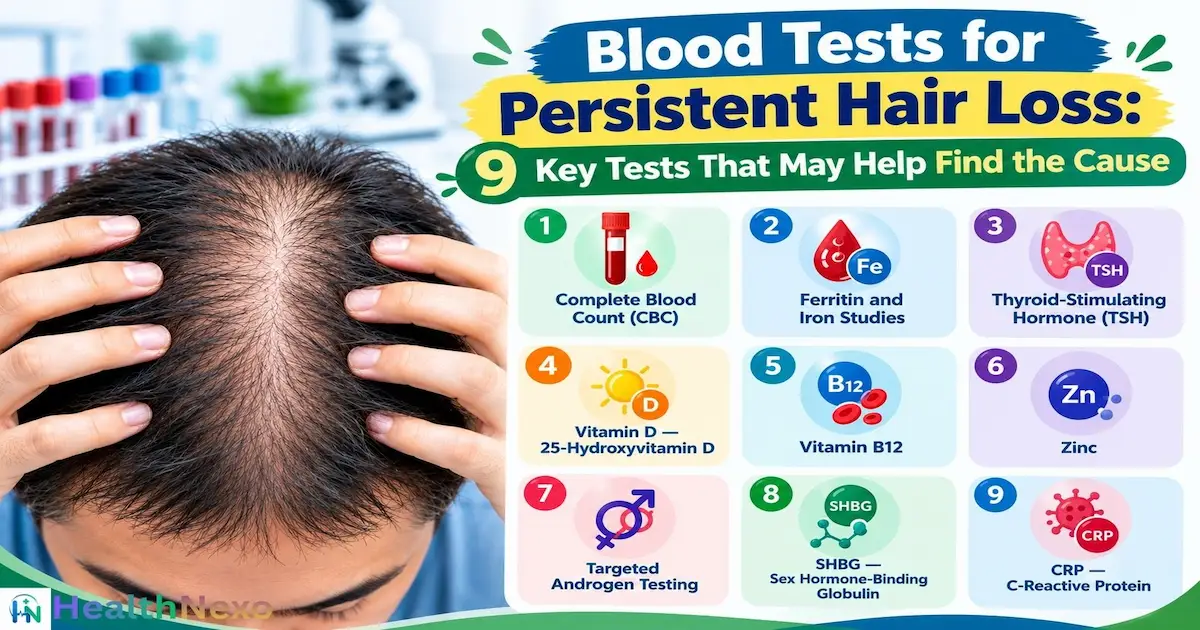
9 Blood Tests for Persistent Hair Loss
Persistent hair loss may sometimes be linked to nutritional deficiencies, thyroid problems, hormonal changes, or other underlying conditions. The following nine blood tests may help identify potential contributors when testing is clinically indicated.
1. Complete Blood Count (CBC): Identifies Anemia and Blood Abnormalities
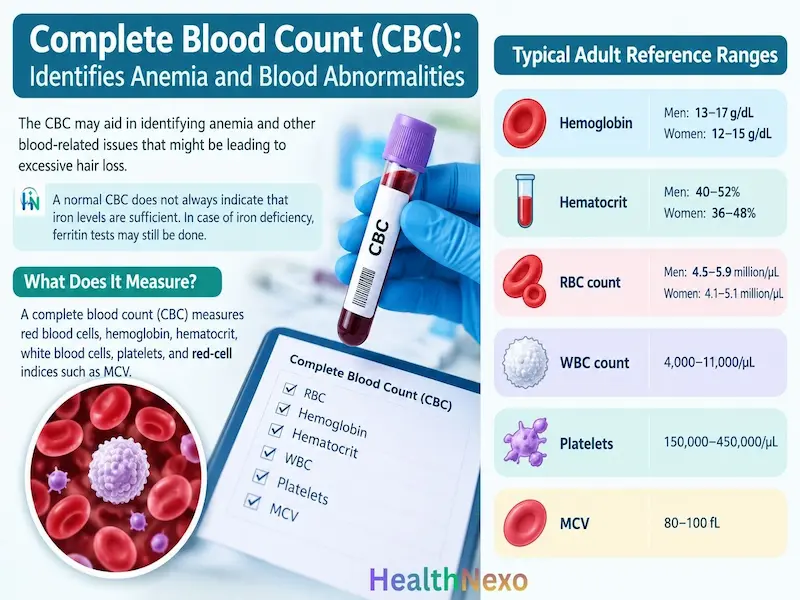
The CBC may aid in identifying anemia and other blood-related issues that might be leading to excessive hair loss. A normal CBC does not always indicate that iron levels are sufficient. In case of iron deficiency, ferritin tests may still be done.
What Does It Measure?
A complete blood count (CBC) measures red blood cells, hemoglobin, hematocrit, white blood cells, platelets, and red-cell indices such as MCV.
Typical Adult Reference Ranges
- Hemoglobin: Men 13–17 g/dL; Women 12–15 g/dL
- Hematocrit: Men 40–52%; Women 36–48%
- RBC count: Men 4.5–5.9 million/µL; Women 4.1–5.1 million/µL
- WBC count: 4,000–11,000/µL
- Platelets: 150,000–450,000/µL
- MCV: 80–100 fL
When Is It Useful?
CBC may be considered when hair loss occurs with:
- Fatigue or weakness
- Heavy menstrual bleeding
- Poor nutritional intake
- Previous blood loss
- Symptoms suggesting anemia
Important: Reference ranges vary between laboratories, age groups, and testing methods.
2. Ferritin and Iron Studies: Assess Iron Stores and Deficiency
Decreased iron levels can be linked to diffuse hair fall, especially among patients suffering from telogen effluvium. But decreased ferritin levels cannot necessarily imply an iron deficiency-induced hair fall. There is no established cutoff for ferritin to diagnose hair fall due to iron deficiency.
What Do They Measure?
Ferritin is a measure of the storage of iron in the body. Depending on various situations, iron testing may also comprise serum iron, TIBC/Transferrin, and transferrin saturation levels.
Typical Adult Reference Ranges0
- Ferritin: Men approximately 24–336 ng/mL; Women approximately 11–307 ng/mL
- Serum iron: Approximately 60–170 µg/dL
- TIBC: Approximately 240–450 µg/dL
- Transferrin saturation: Approximately 20–50%
Reference ranges vary by laboratory and clinical context.
When Is Testing Useful?
Testing may be particularly relevant to:
- Heavy menstrual bleeding
- Low dietary iron intake
- Previous anemia
- Frequent blood donation
- Possible gastrointestinal blood loss
- Persistent diffuse hair shedding
The ferritin levels may be increased in cases of inflammation, infection, liver disease, and numerous other conditions.
3. Thyroid-Stimulating Hormone (TSH): Helps Detect Thyroid Problems
Hair loss could be an indication of either hypothyroidism or hyperthyroidism.
What Does It Measure?
The TSH hormone is synthesized by the pituitary gland and regulates the release of hormones from the thyroid gland. TSH can be used for the preliminary diagnosis of disorders of the thyroid gland.
Typical Adult Reference Range
- TSH: Approximately 0.4–4.0 mIU/L
When Is It Useful?
TSH may be considered when hair loss occurs with:
- Unexplained weight changes
- Fatigue
- Cold or heat intolerance
- Constipation
- Palpitations
- Menstrual changes
If there is any abnormality in the TSH test result, further investigation may be required in the form of a free T4 test.
Note: The intake of biotin-based hair supplements may affect the results of the thyroid tests.
4. Vitamin D — 25-Hydroxyvitamin D: Assesses Vitamin D Levels
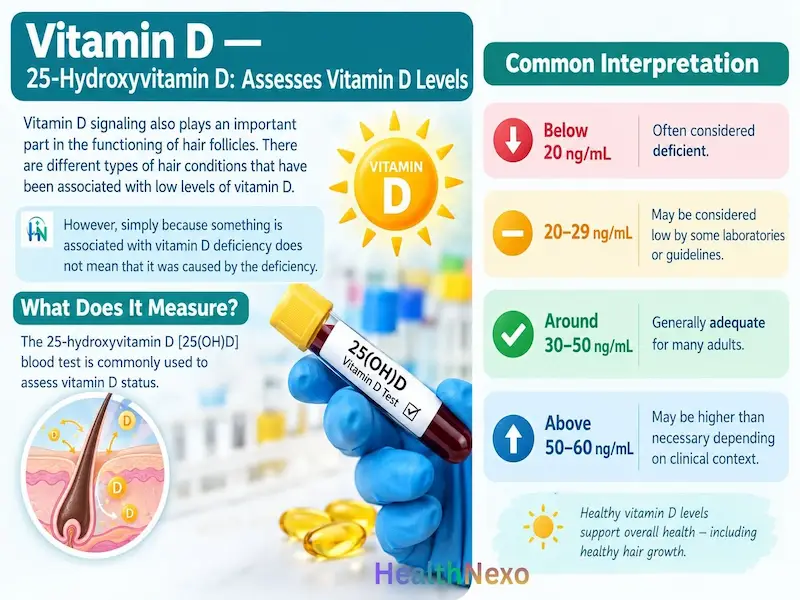
Vitamin D signaling also plays an important part in the functioning of hair follicles. There are different types of hair conditions that have been associated with low levels of vitamin D. However, simply because something is associated with vitamin D deficiency does not mean that it was caused by the deficiency.
What Does It Measure?
The 25-hydroxyvitamin D [25(OH)D] blood test is commonly used to assess vitamin D status.
Common Interpretation
- Below 20 ng/mL: Often considered deficient
- 20–29 ng/mL: May be considered low by some laboratories or guidelines
- Around 30–50 ng/mL: Generally adequate for many adults
- Above 50–60 ng/mL: May be higher than necessary depending on clinical context
Important: The levels of Vitamin D vary according to different sets of guidelines. However, these are only guidelines and do not represent any diagnostic thresholds for hair loss.
When Is Testing Useful?
Testing may be considered when there are risk factors for deficiency, such as:
- Limited sun exposure
- Restricted diet
- Malabsorption
- Certain chronic conditions
- Other clinical signs of deficiency
There is no universally accepted hair-loss-specific vitamin D cutoff.
5. Vitamin B12: Helps Identify Vitamin B12 Deficiency
B12 deficiency causes megaloblastic anemia along with other physiological problems. However, evidence that isolated B12 deficiency directly causes persistent hair loss is limited. Therefore, B12 deficiency should not automatically be considered the cause of hair shedding.
What Does It Measure?
Vitamin B12 test is used to determine the amount of vitamin B12 present in the blood. Vitamin B12 is very important for DNA synthesis, red blood cell production and nerve function.
Typical Adult Reference Range
- Vitamin B12: Approximately 200–900 pg/mL
Levels below about 200 pg/mL are commonly considered low, although laboratory cutoffs vary. Reference ranges vary by laboratory and clinical context.
When Is Testing Useful?
B12 testing may be reasonable with:
- Restrictive diets, particularly vegan diets
- Malabsorption
- Gastrointestinal disease
- Macrocytosis or unexplained anemia
- Numbness or tingling
In selected cases, methylmalonic acid (MMA) may help clarify a possible functional B12 deficiency.
6. Zinc: Helps Identify Zinc Deficiency
Zinc is an element that takes part in protein metabolism, cell division, immune system, and tissue healing. As hair follicles constitute very active tissues, Severe zinc deficiency may disrupt normal hair growth and has been associated with certain types of hair loss.
What Does It Measure?
A serum zinc test measures the concentration of zinc in the blood.
Typical Adult Reference Range
- Zinc: Approximately 60–120 µg/dL
Reference ranges vary by laboratory and clinical context.
When Is Testing Useful?
Testing may be considered with:
- Restrictive diets
- Poor nutritional intake
- Malabsorption
- Gastrointestinal disease
- Other evidence of nutritional deficiency
If there is a low reading, this will indicate a possibility of zinc deficiency but will not necessarily mean it is the reason for alopecia.
Important: Avoid high-dose zinc supplements without professional guidance, as excessive zinc can cause adverse effects and interfere with copper absorption.
7. Targeted Androgen Testing: Helps Detect Androgen Excess
Tests for androgen levels are helpful where hair loss is accompanied by signs of high androgen levels or hormonal imbalance. Not all patients with hair loss need these tests.
What May Be Tested?
Depending on the situation, testing may include:
- Total testosterone: Approximately 15–70 ng/dL in women and 300–1,000 ng/dL in men
- Free testosterone: Reference ranges vary substantially by assay and laboratory
- DHEAS: Reference ranges vary considerably with age and sex
- Androstenedione: Reference ranges vary by laboratory and clinical context
- DHT: No universal hair-loss-specific cutoff
When May It Be Useful?
In women, androgen testing may be considered when scalp thinning occurs with:
- Irregular or absent menstrual periods
- Excess facial or body hair
- New or worsening acne
- Rapidly progressive scalp thinning
- Other signs of androgen excess
These findings may lead to evaluation for hyperandrogenism or PCOS, depending on the overall clinical picture.
What About DHT?
Testosterone can be metabolized to dihydrotestosterone (DHT) via the action of 5-alpha-reductase. DHT contributes to pattern hair loss in genetically susceptible hair follicles.
But DHT levels in the blood are not an indication of androgen sensitivity of each follicle on the scalp. Hence, serum DHT is not required to diagnose pattern hair loss.
Note: Reference ranges for hormones are quite different based on age, gender, menstrual period, type of assay, medication, and many other parameters. Always rely on the reference range supplied by the lab where the test was done.
8. SHBG — Sex Hormone-Binding Globulin: Helps Assess Androgen Levels
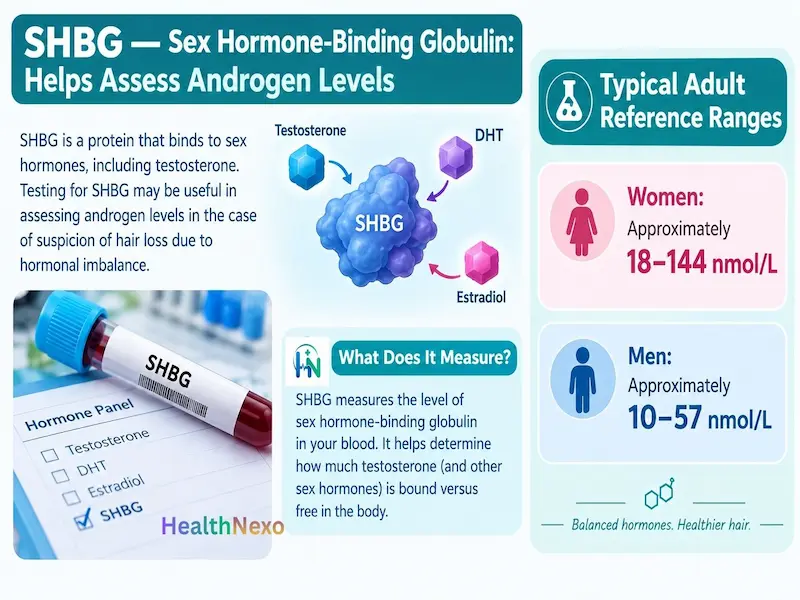
SHBG is a protein that binds to sex hormones, including testosterone. Testing for SHBG may be useful in assessing androgen levels in the case of suspicion of hair loss due to hormonal imbalance.
What Does It Measure?
SHBG is a protein produced mainly by the liver that binds to sex hormones, including testosterone. Measuring SHBG can help clinicians interpret total and free testosterone when hormonal imbalance is suspected.
Typical Adult Reference Ranges
- Women: Approximately 18–144 nmol/L
- Men: Approximately 10–57 nmol/L
Reference ranges vary by laboratory and clinical context.
When May SHBG Be Useful?
SHBG may be considered when hair loss occurs with:
- Irregular menstrual cycles
- Excess facial or body hair
- Acne
- Scalp thinning
- Other signs of androgen excess
Insulin resistance and low SHBG may coexist, but low SHBG occurs in conjunction with PCOS as well. However, the presence of low SHBG alone cannot be used for diagnosing PCOS.
9. CRP — C-Reactive Protein: Helps Detect Inflammation
Although CRP can provide information about inflammation in the body, an elevated value does not mean that the inflammation is responsible for the hair loss.
What Does It Measure?
CRP measures C-reactive protein, which can increase when inflammation or infection is present.
Typical Adult Reference Range
- CRP: Usually <5 mg/L
Some laboratories use a lower upper reference limit, such as 3 mg/L. Therefore, the laboratory’s own reference range should be followed.
When May CRP Be Useful?
CRP may be considered when hair loss occurs with signs of systemic inflammation or infection, such as:
- Fever or unexplained illness
- Joint pain or swelling
- Significant fatigue
- Scalp redness, pain, or tenderness with other inflammatory symptoms
- Other symptoms suggesting an underlying inflammatory condition
An elevated CRP does not prove that inflammation is causing the hair loss. It is not a standard test for common pattern alopecia or for non-inflammatory telogen effluvium.
Blood Tests Cannot Diagnose Every Type of Hair Loss
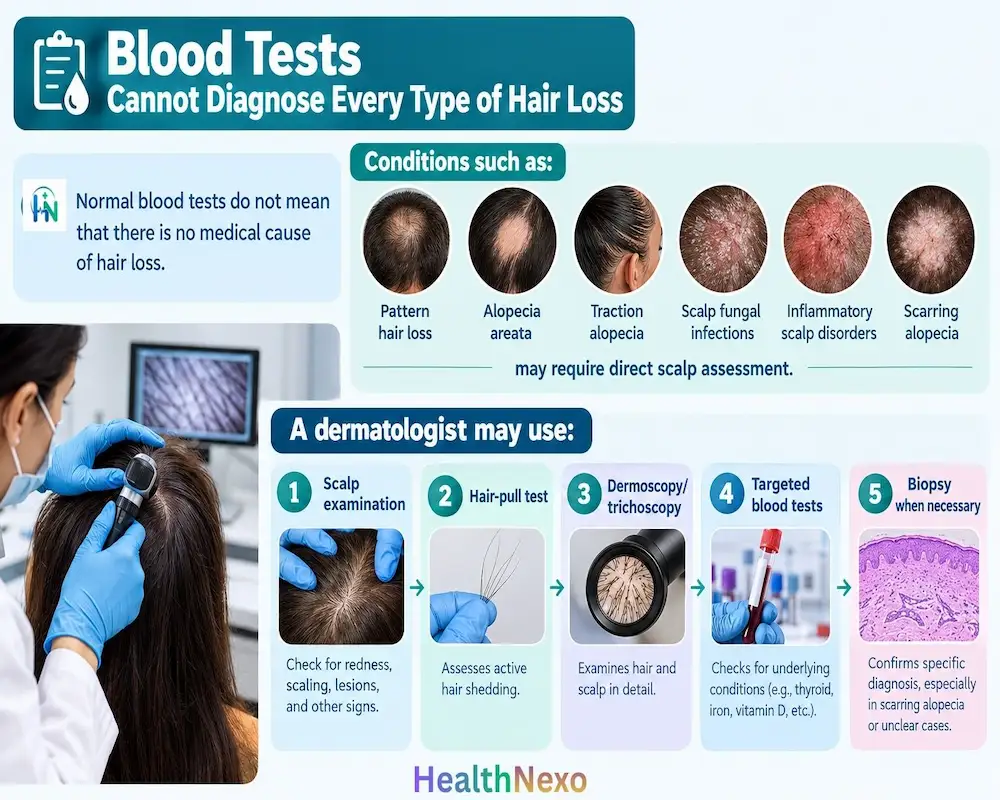
Normal blood tests do not mean that there is no medical cause of hair loss. For younger adults, several newer hair-loss treatment approaches are also being investigated.
Conditions such as:
- Pattern hair loss
- Alopecia areata
- Traction alopecia
- Scalp fungal infections
- Inflammatory scalp disorders
- Scarring alopecia
- may require direct scalp assessment.
A dermatologist may use:
- Scalp examination → Hair-pull test → Dermoscopy/trichoscopy → Targeted blood tests → Biopsy when necessary
Early assessment is particularly crucial when scarring alopecia is considered, because continuous inflammation can cause irreversible harm to hair follicles.
When Should You See a Dermatologist?
Professional evaluation is especially important if hair loss is:
- Sudden or rapidly worsening
- Occurring in distinct patches
- Associated with scalp pain or burning
- Accompanied by significant itching
- Associated with redness, scaling, or sores
- Accompanied by fatigue or other systemic symptoms
- Developing after major illness, surgery, or significant weight loss
- Associated with irregular periods or signs of androgen excess
A dermatologist can determine whether blood testing is necessary and which tests are most appropriate.
Do Hair-Loss Supplements Really Help?
Not automatically.
Hair loss alone is not a sufficient reason to take iron, zinc, vitamin D, B12, biotin, or other supplements.
If testing confirms a nutritional deficiency, correcting it may help address an underlying contributor. However, excessive use of supplements has its own share of adverse effects.
A better approach is:
- Identify the hair-loss pattern → Evaluate possible causes → Test when indicated → Treat confirmed problems → Monitor recovery
Bottom Line
Blood tests for persistent hair loss can help identify potentially treatable contributors, but they are only one part of the diagnostic process. For cases of unexplained hair loss, CBC, ferritin/iron analysis, and TSH are some of the common initial tests conducted. Vitamin D, B12, and zinc could be done if deficiency is suspected, while androgens, SHBG, or CRP can be performed based on symptoms.
Best approach:
- Targeted blood tests + scalp examination + individualized treatment rather than testing for every possible cause.
Frequently Asked Questions (FAQs)
Q1. What are the most useful blood tests for persistent hair loss?
For unexplained diffuse shedding, CBC, ferritin/iron testing, and TSH are frequently used as initial screening tools. Further diagnostic work is based on symptoms and risk factors.
Q2. Is ferritin important for hair loss?
Yes. Ferritin can be used to gauge iron stores and may be applicable in hair shedding. But there isn’t a defined ferritin concentration that confirms that iron deficiency causes hair loss.
Q3. Can thyroid problems cause hair loss?
Yes. Both hypothyroidism and hyperthyroidism can be associated with hair thinning or increased shedding.
Q4. Should everyone get all nine tests?
No. The tests are not mandatory hair loss tests. The tests need to be tailored according to the symptoms, history, diet, medication, and clinical findings.
Q5. When should hormone tests be done?
Androgen testing is mainly considered when there are signs of androgen excess, such as irregular periods, acne, excess facial hair, or rapidly progressive scalp thinning.
Q6. Is CRP a routine hair-loss test?
No. CRP is generally considered when symptoms or examination findings suggest inflammation or systemic disease.
Medical Disclaimer
This article is intended for educational purposes and should not be used as a substitute for professional medical guidance. Laboratory normal ranges will differ based on many parameters including laboratory, methodology used, age, gender, pregnancy, medications, and other clinical parameters. Always follow the normal range reported along with your lab report.
Never take any supplements merely because you are losing hair or have an abnormal lab report. Seek medical consultation from a professional.
Scientific Sources
- American Academy of Dermatology (AAD) — Hair Loss: Diagnosis and Treatment
- MedlinePlus — Complete Blood Count (CBC)
- MedlinePlus — Ferritin Blood Test
- American Thyroid Association — Thyroid Function Tests
- PubMed Central — Telogen Effluvium: A Review
- PubMed — Telogen Effluvium in Daily Practice
- American College of Obstetricians and Gynecologists (ACOG) — Evaluation of Androgen Excess
Tags:

Md. Rakibul Hasan, BSc (Hons), MS (Thesis)
Biochemistry & Molecular Biology, University of Chittagong, Bangladesh
Senior Biochemist | Health Content Writer | Evidence-Informed Health Information Creator
Popular Diagnostic Centre Limited, Bangladesh.
He specializes in clinical biochemistry, laboratory diagnostics, and medical testing. Alongside his professional work, he is actively involved in health education and scientific communication.
As a Health Content Writer and Research-Based Health Information Creator, he simplifies complex medical and biochemical topics into clear, evidence-informed, and reader-friendly health information.